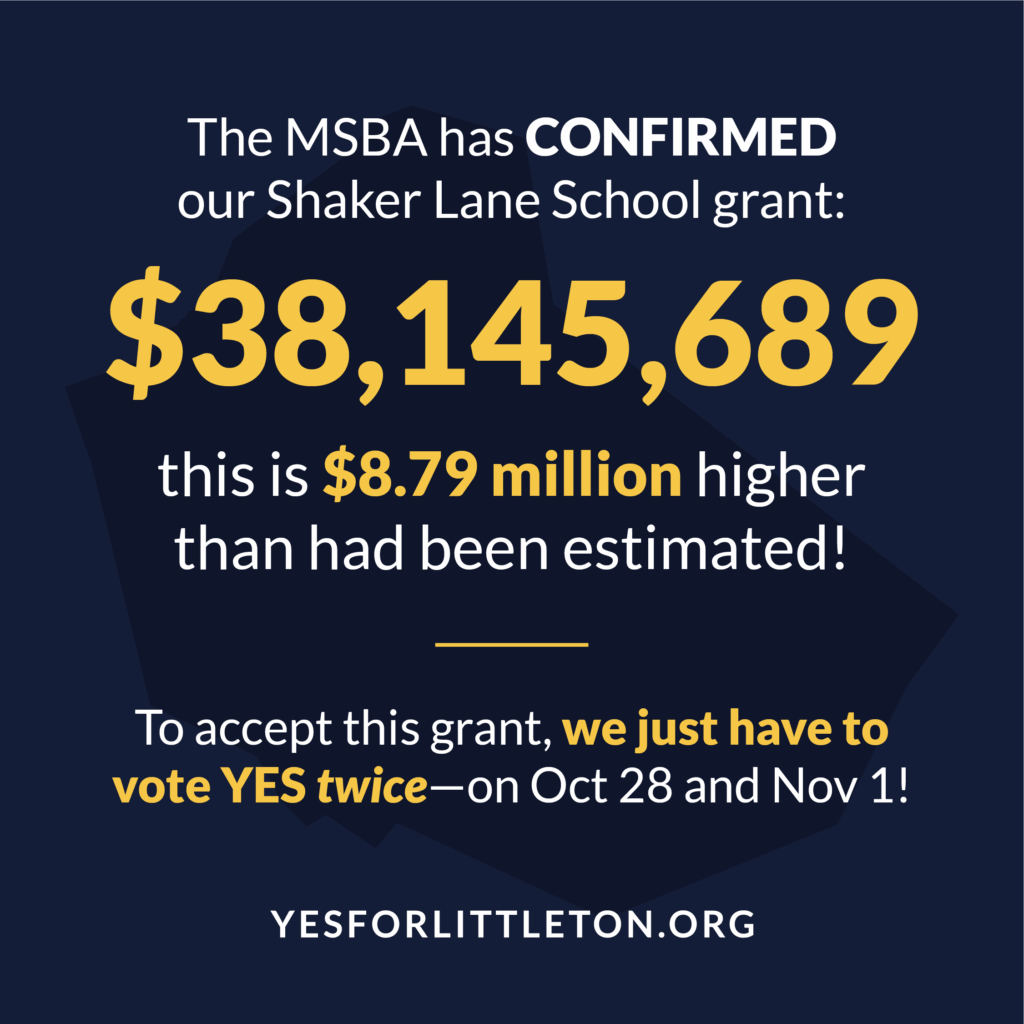
The MSBA is a state agency that partners with local communities to create affordable, sustainable, and energy efficient public schools across Massachusetts. It’s a competitive and needs-based program with an acceptance rate as low as 10–15%. An MSBA grant can be worth tens of millions, however; Littleton was awarded $38,145,689 for the Shaker Lane School Building Project.
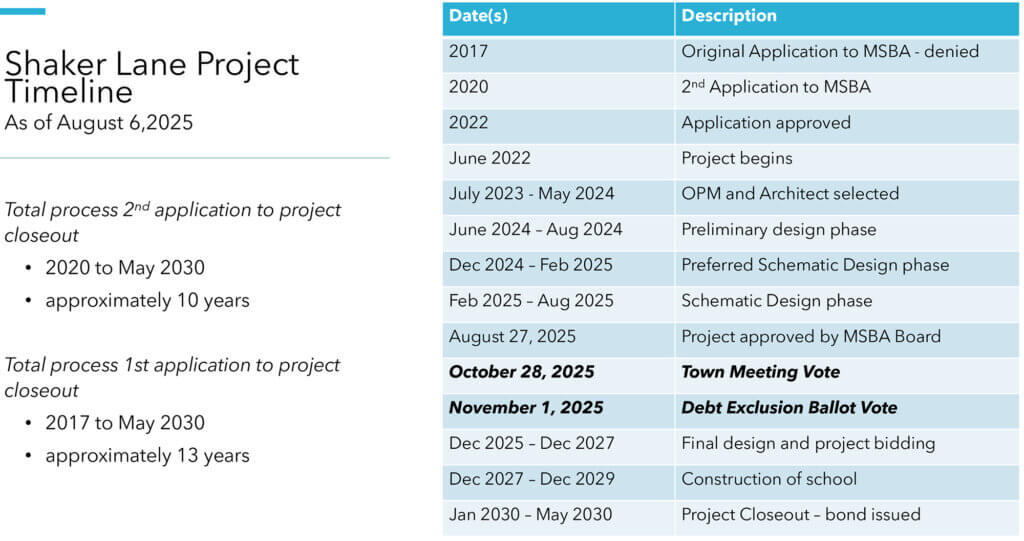
Littleton first applied to the MSBA program for Shaker Lane School back in 2017 and was denied. In 2020, the Shaker Lane School Project Team submitted a second application. Shaker Lane was finally accepted into the program in 2022, one of only 17 projects across the state selected in that round.
The project is now in our hands—it’s time to vote YES for a new Shaker Lane.
Why work with the MSBA?
Besides the financial benefits of an MSBA grant, working with the MSBA ensures a right-sized school tailored to our town and its growing population. The reimagined Shaker Lane School is designed for 21st century learning, flexibility, sustainability, and affordability.
The district works together with its design team, Owner’s Project Manager, and local stakeholders to develop, evaluate, and select a design that supports the town’s educational plan. The MSBA wants to help as many communities as possible improve their schools, and that can only be done by making sure the projects that receive MSBA money are doing so in a fiscally responsible manner.
Design Update from the June 24, 2025 Shaker Lane School Community Forum Presentation
Shaker Lane Project Update, September 2025
Sustainability
Buildings are the second largest source of greenhouse gas emissions in Massachusetts, responsible for 35% of statewide emissions in 2021, behind transportation at 38% (mass.gov).
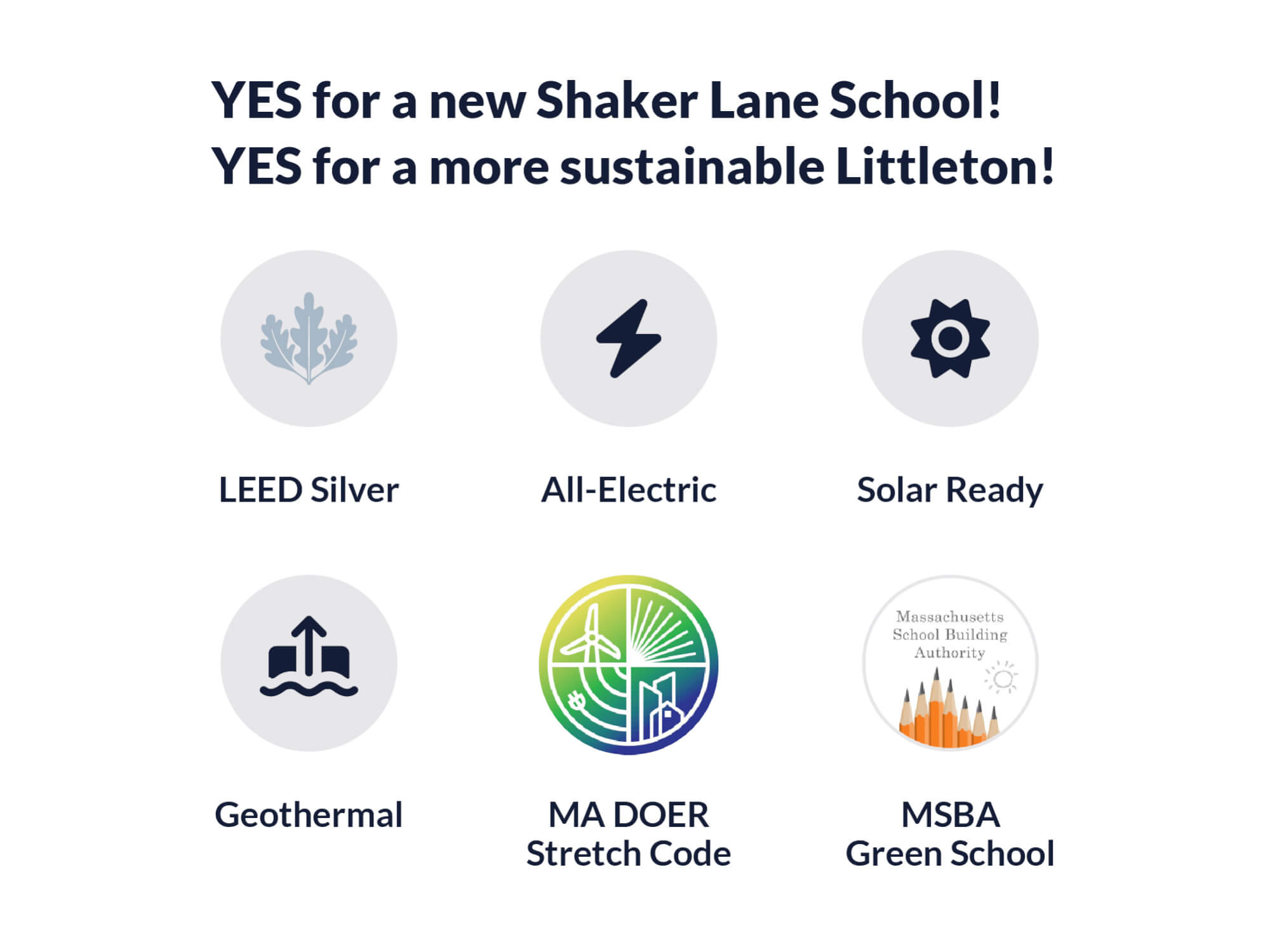
The new Shaker Lane School will be LEED Silver certified, all-electric and will utilize a geothermal ground source heat pump system. As the grid becomes greener, the emissions associated with geothermal heat pumps and other electric systems decrease.
The current Shaker Lane School has an inefficient natural gas boiler—well past its useful lifespan—that emits carbon dioxide directly through combustion. Code repairs to the current building would mean replacing like with like—a natural gas boiler would be replaced with a natural gas boiler—a huge step backward for sustainability.
The MSBA has established several sustainable green programs for all MSBA-funded projects, with an increased emphasis on reducing energy consumption and improving indoor air quality. The MSBA also requires and pays for the entire cost of building commissioning for all MSBA-funded projects to ensure that these buildings operate efficiently and as designed.
The new Shaker Lane School will have a positive part in Littleton’s Climate Action Plan. Littleton can do its part in lowering statewide emissions by voting YES for Shaker Lane this fall.
The Littleton Sustainability Committee fully supports Littleton’s plan to build a new Shaker Lane School—given that the upgrading and retrofitting of the current Shaker Lane School structure provides very limited opportunities to include energy efficient and sustainable features for environmental benefit—the proposed project incorporates sustainable design features that align with Littleton’s climate and energy goals, including LEED Silver certification, all-electric and solar-ready systems, geothermal heating and cooling, and the use of healthy building materials.
Sustainability benefits of the new Shaker Lane School
What is geothermal?
Geothermal heat pumps (GHPs), also known as ground-source heat pumps, can heat and cool a building by transferring heat to or from the ground. This technology has been around for more than 50 years. Virtually all of the parts for a GHP system (ground heat exchangers, heat pumps, etc.) are made in the United States and the installation of GHPs can never be outsourced. This helps stimulate local economies by hiring area contractors to dig holes and install each GHP system.
Although upfront costs can he higher, GHPs are up to 65% more efficient than traditional HVAC units and pay for themselves over time in energy savings, typically within 10 years. The new Shaker Lane School’s geothermal heat pump will save the town in energy costs and will lower Littleton’s greenhouse gas emissions.
Positive impacts on the community
A new Shaker Lane School will benefit our town’s youngest learners and the community at large:
LEED Silver certification and an all-electric design align with Littleton’s long-term sustainability goals
Shaker Lane School will be able to fully meet the district’s educational plan, with flexibility to adapt to future changes in teaching methods and future expansion
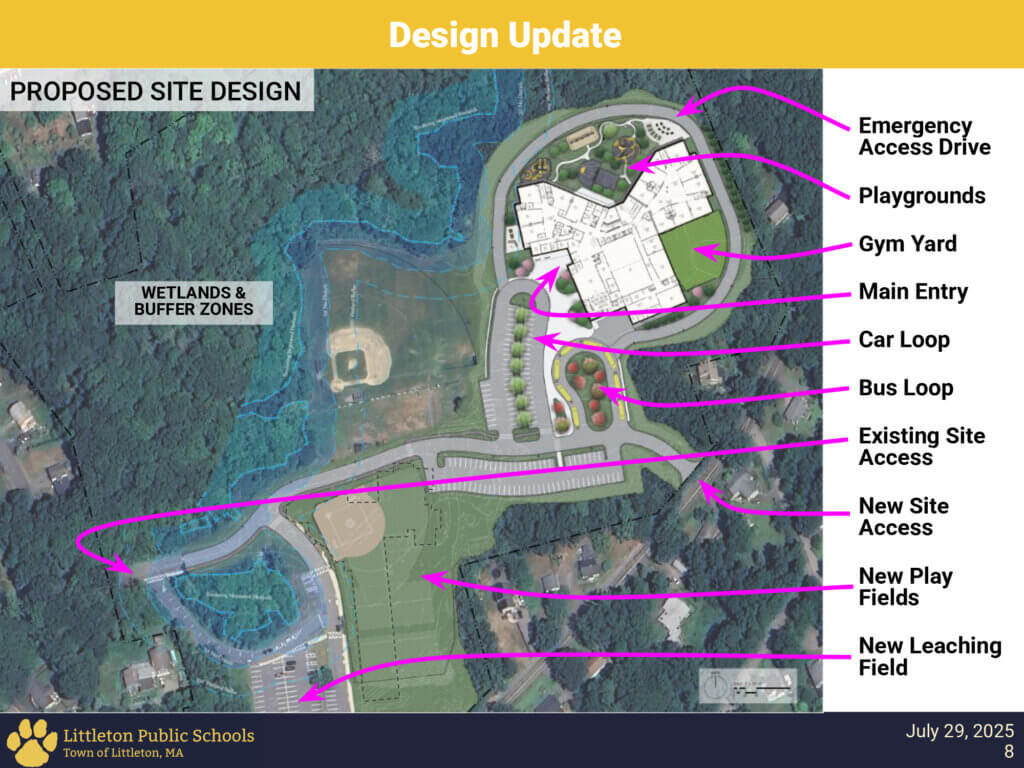
Accessible athletic fields will be graded after the current school is demolished (with a $3 million grant from the state) with ample parking nearby
Controlled access will allow for community use of the building, playgrounds, and fields
Separate car and bus loops—with new site access and a longer driveway—will greatly increase student safety and eliminate the traffic nightmare on Goldsmith Street at drop-off and pick-up
The project will create jobs during construction, benefiting local contractors and suppliers
Design Update from the July 29, 2025 Shaker Lane School Community Forum Presentation
The student population is evolving
In the US, approximately 20% of students require additional support for things like learning disabilities, language learning, and behavioral issues, plus testing and evaluations to determine how to best help the students. In Massachusetts, the number is closer to 23% and at Shaker Lane School, it is over 24%.
This support comes in the form of one-on-one instruction and small group sessions. Most of these supports can’t be easily provided in a classroom setting, and some of them, like testing and evaluations, require quiet, private spaces.
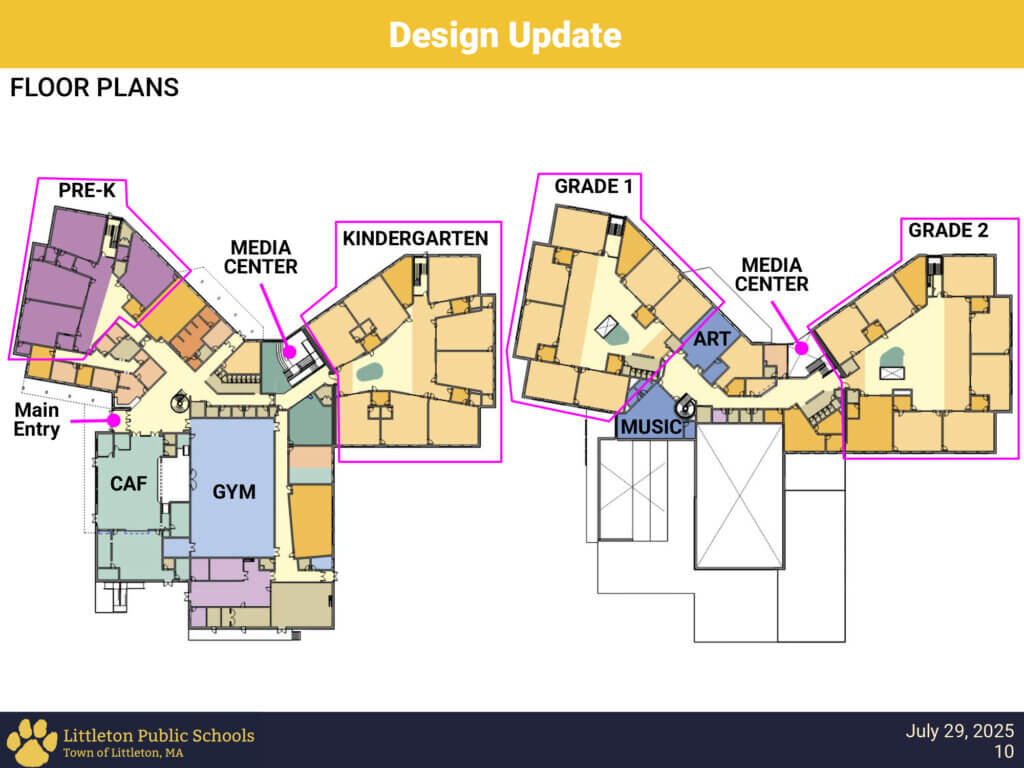
To address this need, the reimagined Shaker Lane provides three learning centers (one for each grade K–2) for special education teachers to provide intensive support. 18 rooms for individual and small group support are scattered throughout the entire school; every classroom has direct access to a small group room, minimizing travel and reducing time students spend out of their classrooms.
Design Update from the July 29, 2025 Shaker Lane School Community Forum Presentation
What is PACE?
Littleton Public Schools’ PACE (Personalized Academic & Comprehensive Education) Program allows students to stay in their home schools and be educated in the least restrictive environment, providing opportunities for highly structured direct instruction as well as inclusion in small and larger groups for social and academic instruction. The PACE Program staff is comprised of a collaborative team of educators, counselors, specialty service providers, support staff, administrators and health care providers.
Shakey, the Shaker Lane School mascot, presents the long-standing core values of H.E.A.R.T.
The reimagined Shaker Lane School includes:
Two PACE classrooms (one for Pre-K and one for K–2), with a bathroom attached to each. Toileting skills and supervision/assistance are a critical component of Littleton’s special education program; the existing PACE classrooms have bathrooms located down the hall.
A dedicated Adaptive PE room with easy access to outdoors and small Quiet Cafe dining rooms within the cafeteria. The gym and cafeteria can be overwhelming to students with sensory issues.
A centrally located Occupational Therapy/Physical Therapy room. Minimizes travel time.
A collaborative team office for all the specialists who provide student services so they can easily work as a team to best support each student and their family.
Multiple conference rooms located near the main entrance to provide a private meeting space for families and specialists. The existing school has only one conference room located far from the main entry.
Learning everywhere
21st century learning is about flexibility and building “soft skills” (rather than focusing solely on technology, which can change so quickly). The top skills employers will be looking for when these students enter the job market are all soft skills such as communication, collaboration, cooperation, creativity, and critical thinking.
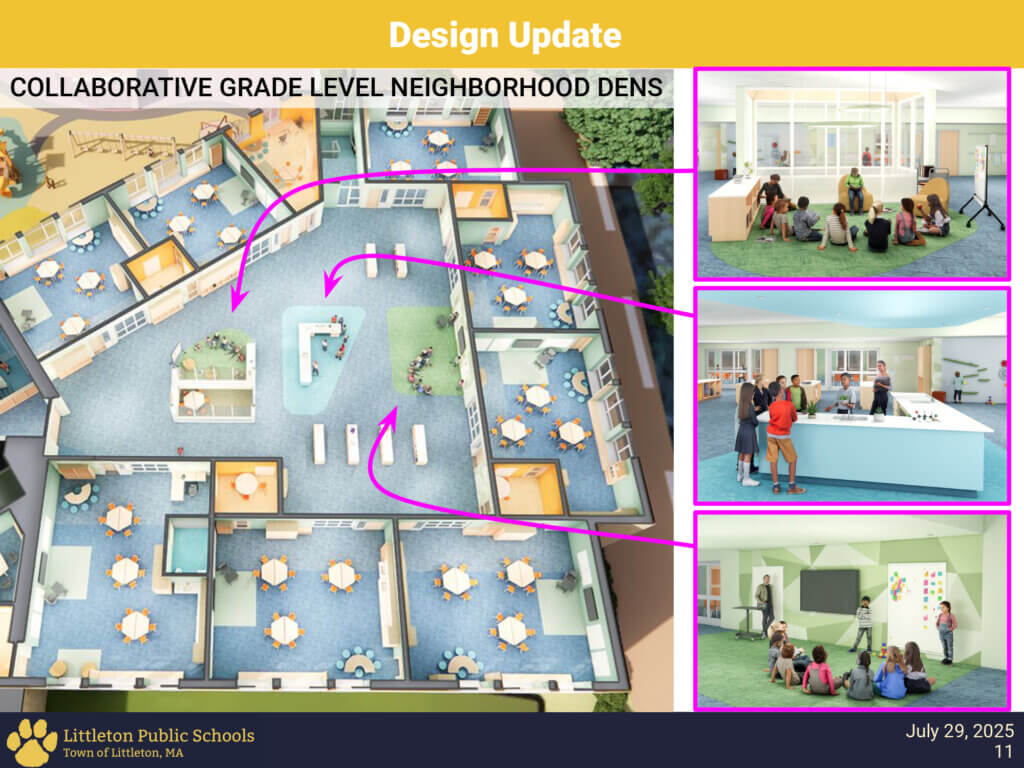
Instead of a traditional hallway, the reimagined Shaker Lane School transforms that same square footage into a central grade-level neighborhood. These “Learning Dens” are set up to foster social skills, build community, and allow for all kinds of different teaching and learning scenarios. The Dens provide ways for classrooms to interact with each other and with students from other grade levels. They allow for interdisciplinary learning where teachers work as a team to enrich the curriculum. The new school was custom designed to support Littleton’s educational plan.
Shaker Lane’s commitment to Universal Design for Learning drives the creation of inclusive and supportive educational environments, ensuring that lessons are designed to cater to a diverse range of student needs. The goal: accessibility and engagement for all.
Design Update from the July 29, 2025 Shaker Lane School Community Forum Presentation
Here’s our “why”
21st century learning is about immersive, hands-on, interactive learning, not memorization. This improves engagement and learning outcomes and sets these students up to become lifelong learners. Investment in early education has a huge impact on the lives of students.
A school to truly be proud of
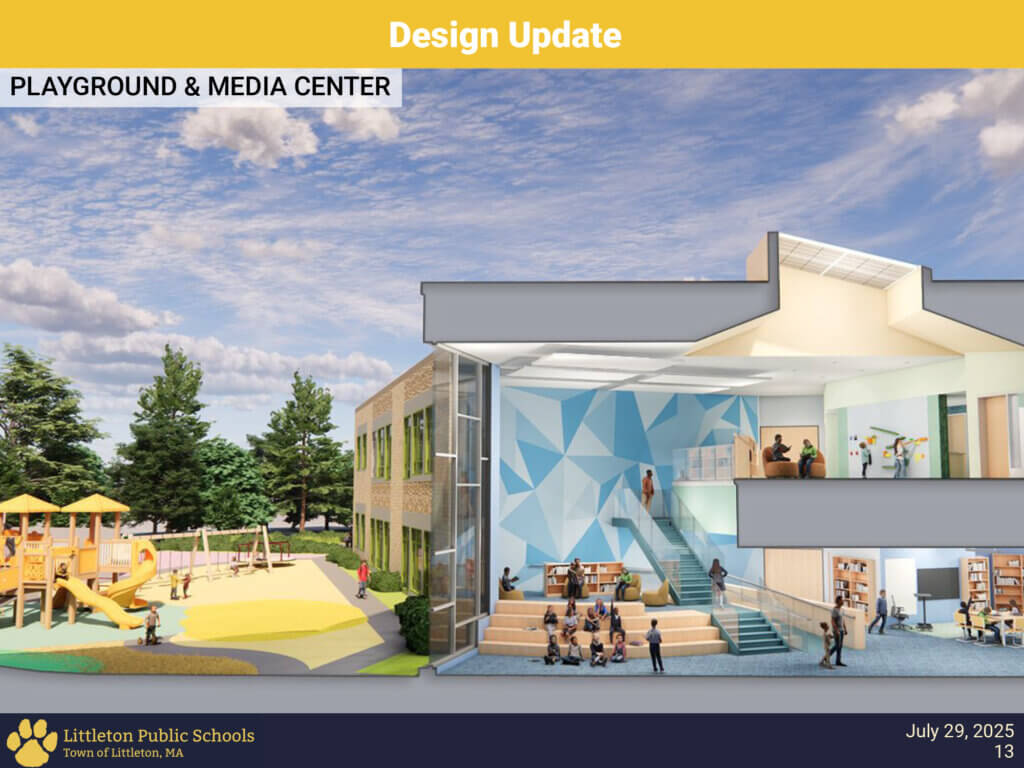
Many spaces in the school serve at least two purposes. For example, the library media center classroom area can be closed off and used as a meeting space or for staff professional development while the reading room or media center satellites are still used for the library session, eliminating disruptions to students. The scale of the building is low and modest, which both helps with costs and is an appropriate design for these youngest learners (ages 3–8).
The building is designed for controlled-access community use, adding valuable meeting space for the town.
These design considerations ensure every square foot is well-worth the cost.
Design Update from the July 29, 2025 Shaker Lane School Community Forum Presentation
The work is worth it
Our grant from the MSBA is GUARANTEED at $38.2 million, lessening the impact on Littleton’s taxpayers. There is no guarantee we can obtain an MSBA grant in the future if this project doesn’t pass Town Vote this fall. Getting back into the pipeline can delay the project by 7–10 years and will require duplicating the work done and costs spent thus far.
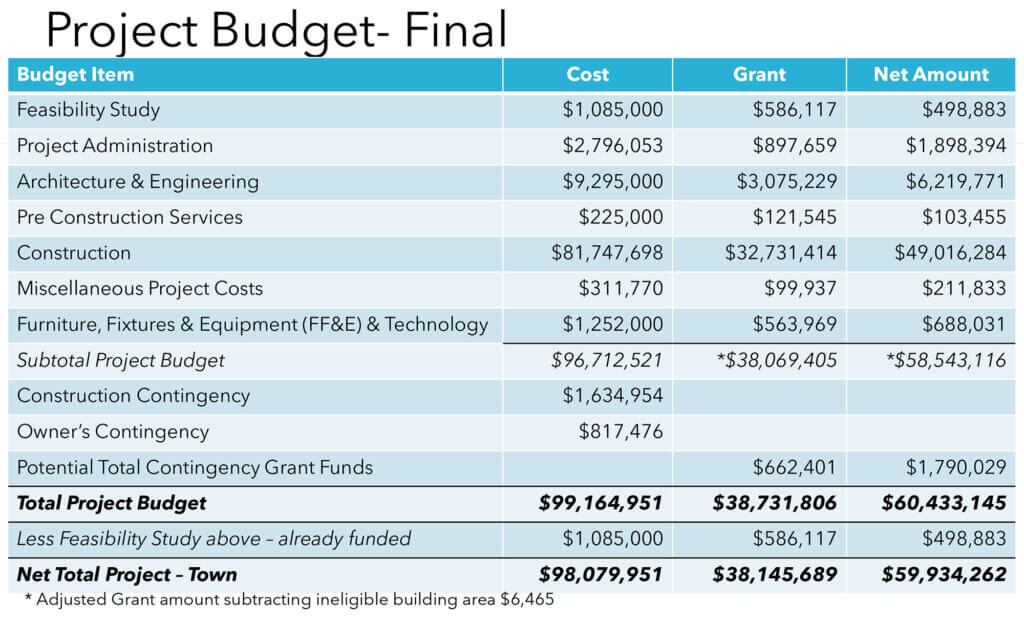
“Project Budget—Final” from the September 2, 2025 Finance Committee Joint Meeting with Select Board, School Committee and Shaker Lane School Building Committee Presentation
Let’s look at costs
This will be the most expensive project Littleton has undertaken to date; the Project Team respects this and has been working diligently to reduce project costs and the resulting impact on taxpayers.
As a result of their efforts, the estimated total project cost has been reduced to $98.1 million. Our $38.2 million MSBA grant results in a net cost to the town of $59.9 million. Littleton’s Select Board, Finance Committee and School Committee have further reduced the burden on taxpayers, resulting in a bond of $50.7 million—the amount Littleton’s taxpayers are ultimately responsible for.
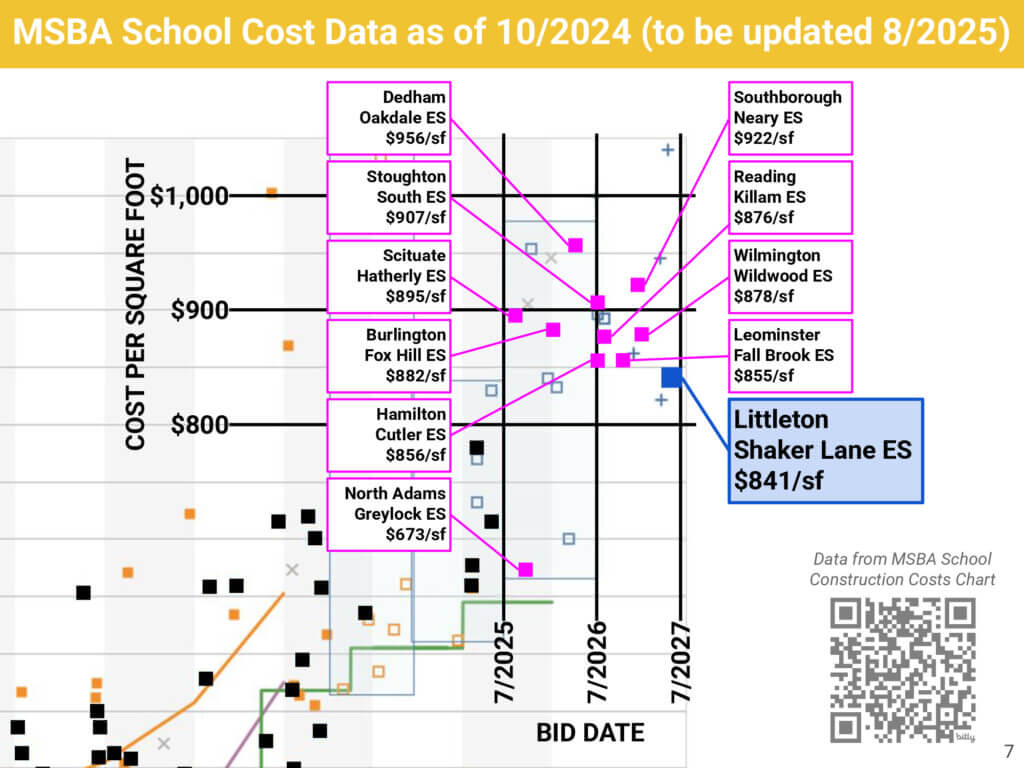
Littleton’s estimated cost per square foot is competitive across MSBA projects
Among MSBA elementary school projects with a similar bid date, Littleton’s cost per square foot is at the low end, with an estimated $841/sf. Compare this to projects in Southborough ($922/sf), Reading ($876/sf), Wilmington ($878/sf), and Leominster ($855/sf). The price per square foot will only increase for future projects, as the trend line shows.
A NO vote sends Littleton back to the drawing board—literally—resulting in even higher costs down the road.
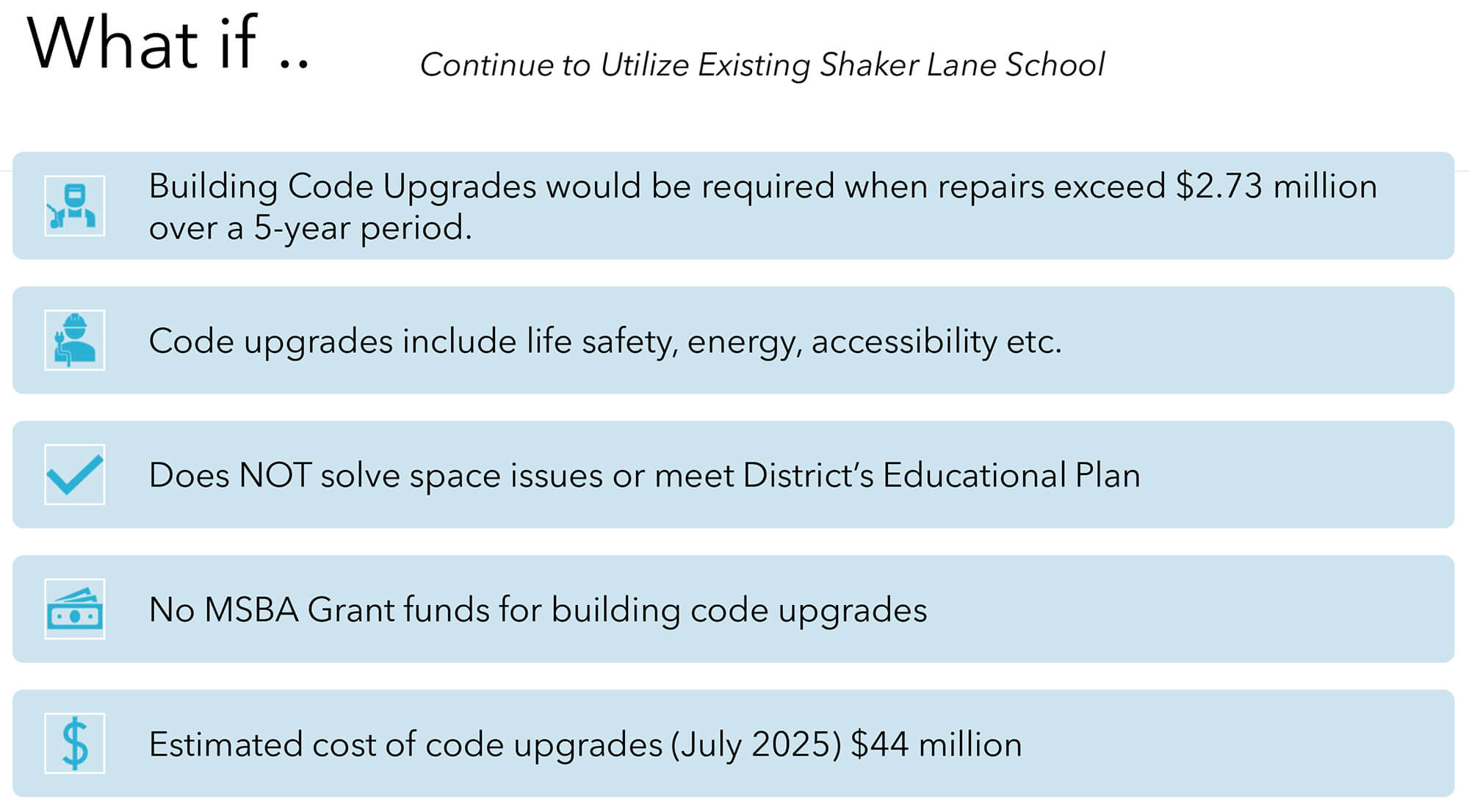
“What If... Continue to Utilize Existing Shaker Lane School” from the September 2, 2025 Finance Committee Joint Meeting with Select Board, School Committee and Shaker Lane School Building Committee Presentation
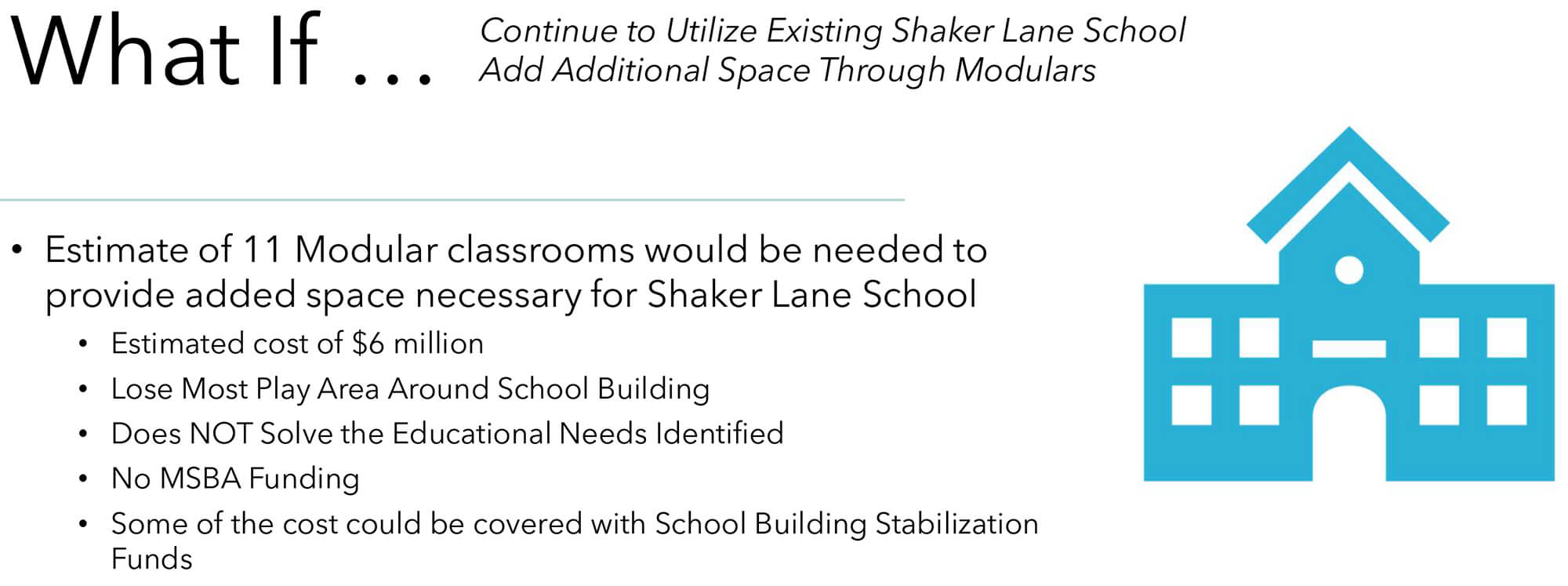
“What If... Continue to Utilize Existing Shaker Lane School, Add Additional Space Through Modulars” from the September 2, 2025 Finance Committee Joint Meeting with Select Board, School Committee and Shaker Lane School Building Committee Presentation
The cost of doing nothing will be steep
If the Shaker Lane School Building Project fails to pass Town Vote, the town will need to invest millions in repairing the existing building—this is NOT renovation. Many critical systems are at or beyond their expected lifespan, and Littleton will be 100% responsible for repairing or replacing systems as they fail. Emergency repairs will negatively impact student learning, and school closures could spell disaster for caregivers and families.
An additional $6 million will need to be spent to provide modular classrooms to provide the added space necessary for Shaker Lane School. This temporary measure is wasteful spending—it will not solve the educational delivery issues, will take up most of the current outdoor play space and will become a logistical nightmare for students and staff alike.
Shaker Lane School is beyond its life expectancy. Boilers breaking down in the dead of winter could prove disastrous, both financially and logistically—and the risk of this happening increases every year.
Bringing an aging building up to code
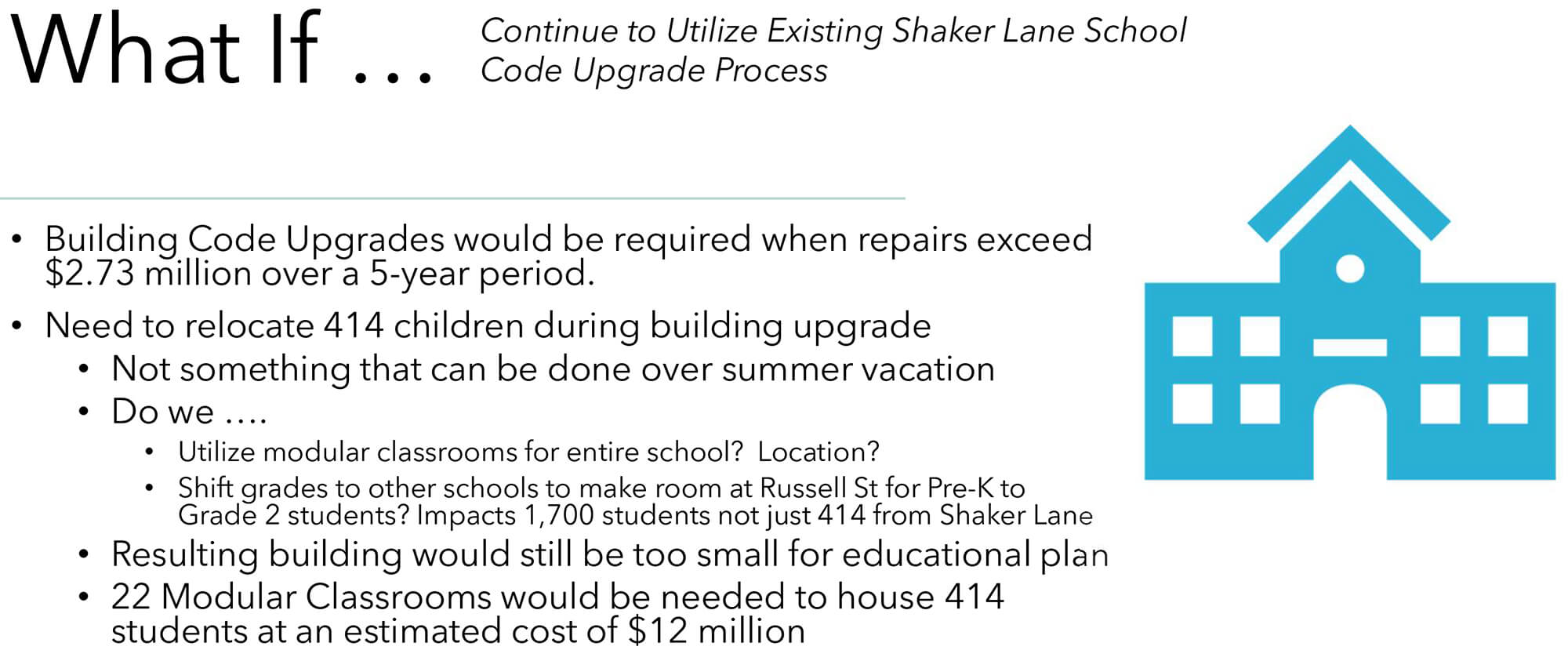
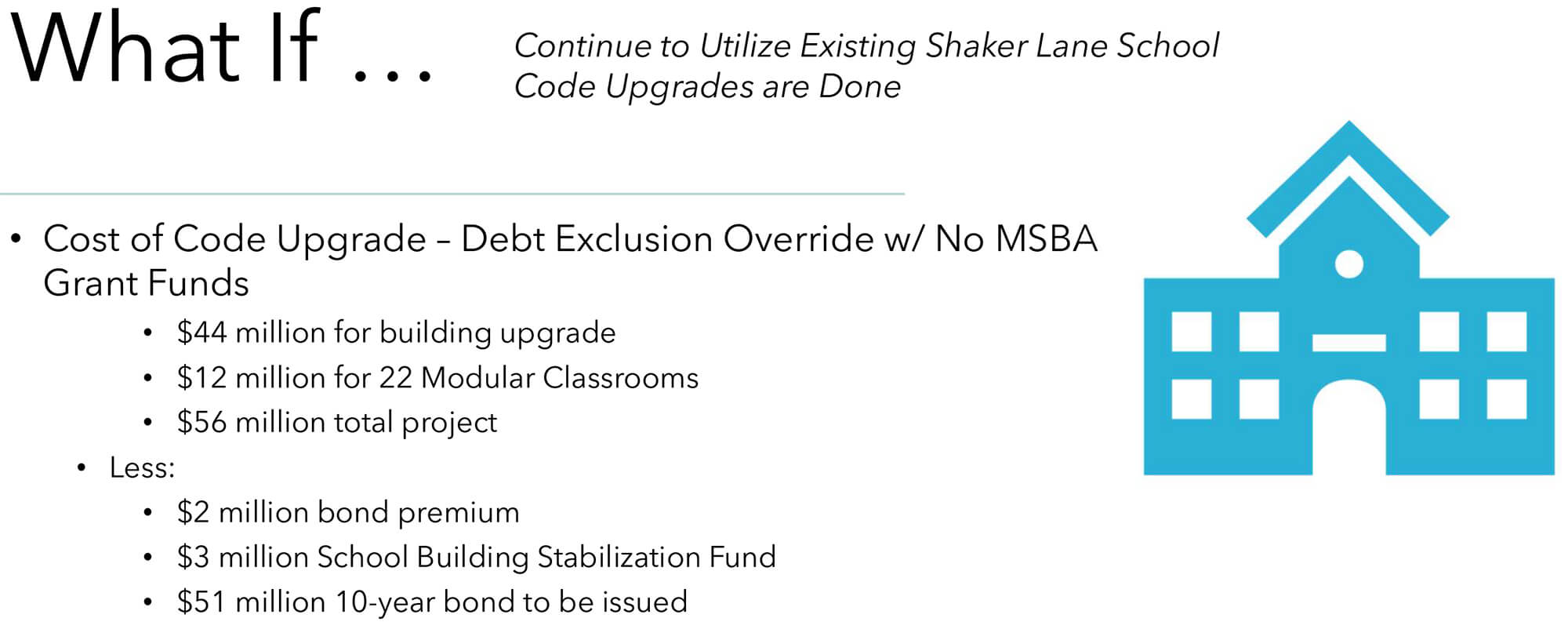
When repair costs inevitably exceed $2.73 million (or 30% of the assessed value of the building) over the course of 5 years, a full code upgrade will be required. This will cost the town an estimated $44 million just to shore up a failing building. None of this spending will be reimbursed by the state; the burden of maintaining the current school building will be fully on the town and its taxpayers. In a time of such uncertainty, this spells trouble.
Many required upgrades would mean the reduction of educational space—which is already at a premium.
For example, an up-to-code elevator is substantially larger than the existing lift at Shaker Lane; surrounding rooms will have to get smaller to accommodate it. Enlarging a bathroom to meet ADA accessibility standards will mean cutting space from adjacent classrooms.
The current $44 million estimate does not include getting the building to meet current energy codes. Meeting energy codes would require substantial modifications to all exterior walls, windows, doors, and the roof.
An additional $12 million will need to be spent to provide 22 modular classrooms for the entire school while code upgrades are underway. Grades may need to be shifted to other schools to make room at Russell Street for Pre-K to grade 2 students. This would affect 1,700 students across the district, not just the 414 from Shaker Lane.
“What If... Continue to Utilize Existing Shaker Lane School, Code Upgrade Process” from the September 2, 2025 Finance Committee Joint Meeting with Select Board, School Committee and Shaker Lane School Building Committee Presentation
“What If... Continue to Utilize Existing Shaker Lane School, Code Upgrades are Done” from the September 2, 2025 Finance Committee Joint Meeting with Select Board, School Committee and Shaker Lane School Building Committee Presentation
A YES vote buys us:
A brand new, sustainable, Shaker Lane School designed for 21st century learning, accessibility, and growth, built on the fields behind the current school to avoid disruptions to student population, plus new fields—all with $38.2 M in grant funding.
GUARANTEED total project cost: the final appropriation amount to be approved at Town Meeting; this is not the taxpayers’ cost
$98.1 M
GUARANTEED MSBA grant: increased by $8.8 M and ours for the taking
Est. split tax impact, year 1 (FY30): “first year, worst year”—bill will decrease each year; based on the average FY25 Littleton home value of $694,868; bond term 20 years; reflects estimated future split tax rates; Debt Exclusion Stabilization fund pays 14.35% of debt over 20 years
$719.20 ($60/mo)
A NO vote buys us:
At least ten years of maintenance on the existing building, code upgrades (not renovations), enough modular classrooms for the entire school. Then, the cost of a new Shaker Lane School including years of cost escalation and no grant funding.
Estimated cost of code upgrades: final cost may be higher; will worsen space issues and require modular classrooms
$44 M
Estimated cost of modular classrooms: 22 modulars needed for all 414 students during repairs
$12 M
Estimated net project cost:
$56 M
Estimated net bond amount: estimated cost to Littleton’s taxpayers, reduced by $5 M by the Town
$51 M
Est. tax impact, year 1: “first year, worst year”—bill will decrease each year; based on the average FY25 Littleton home value of $694,868; bond term 10 years
$1,494.77 ($125/mo)
PLUS a new Shaker Lane School: reflects 10 years of cost escalation compounded at a 5% annual increase
$161.5 M
A new Shaker Lane School is inevitable
A new school must be built, as the current building is well past its useful lifespan, is roughly two-thirds the size it should be to serve Littleton’s growing population (per MSBA guidelines) and poses a danger to the health and safety of the student body and staff:
There is no fire protection sprinkler system
Many elements are not ADA compliant, including play equipment, parking, entry doors, toilet rooms, signage, doors/door handles, handrails, and plumbing fixtures
There are asbestos-containing materials, most of the plumbing has high lead content, and there is lead paint
Inadequate HVAC systems result in dangerous temperatures in classrooms
There are security concerns with the main entry point of the school
The site circulation does not have clear separation of buses, cars, and pedestrians, posing a danger to students, staff, and families
The kitchen is undersized, poorly equipped, and does not meet health code
The electrical system is at capacity
Drinking water is available only at a limited number of drinking and bottle filling stations; there is no access to water in the gym
“A Few of the Issues with the Existing Shaker Lane School” from the July 29, 2025 Shaker Lane School Community Forum Presentation
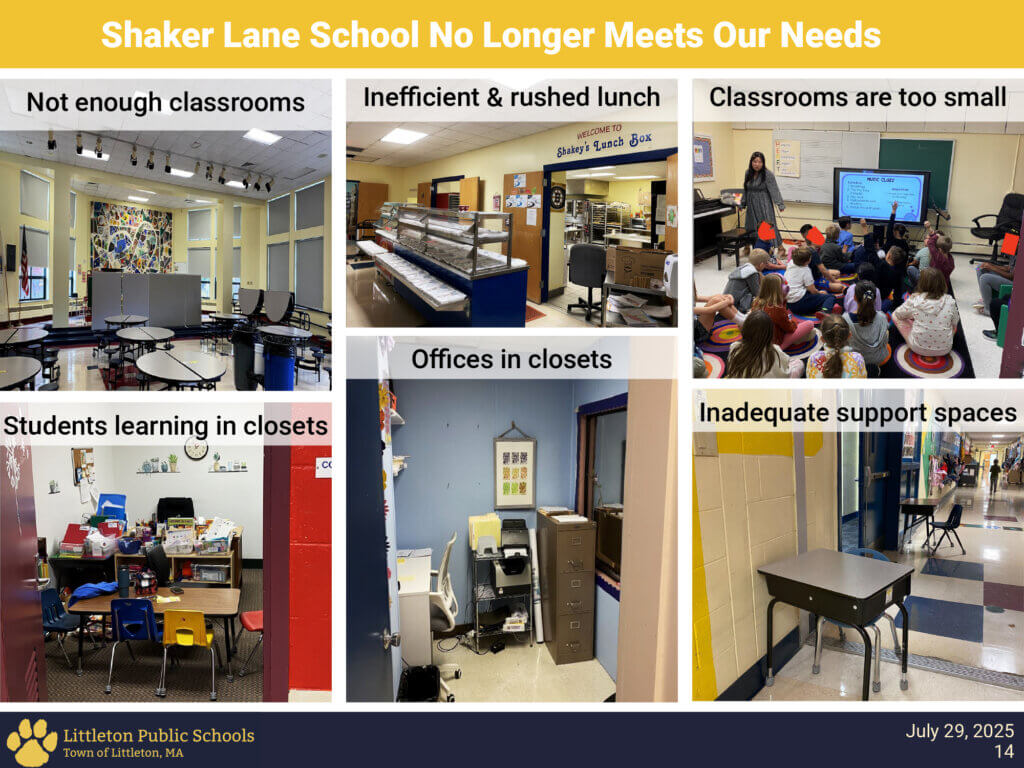
“Shaker Lane School No Longer Meets Our Needs” from the July 29, 2025 Shaker Lane School Community Forum Presentation
What if the project fails at Town Votes?
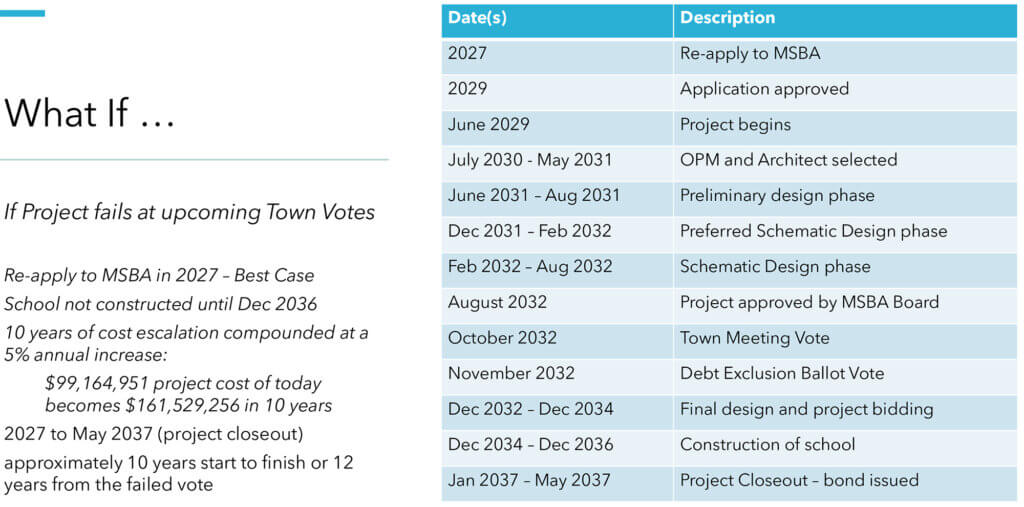
If we vote NO, we will be throwing away a $38.2 million grant, as well as over $1 million in project costs thus far. There is no guarantee we will be invited back into the MSBA program if we do not vote YES this fall.
The cost of building a new Shaker Lane School will increase. Recent building construction inflation rates have trended at 5% annually. A $99,164,951 project cost of today becomes $161,529,256 in 10 years.
If the decision is made not to construct a new Shaker Lane School at this time, the Town and its taxpayers must maintain the aged building until a new one can be built.
Modular classrooms would need to be purchased and installed to address space issues (estimated at $6 million), which would all but eliminate outdoor play space.
Any work done in the building exceeding approximately $2.7 million would require the Town to bring the building up to current code (estimated at $44 million), and enough modulars would be needed for the entire school population during construction ($12 million). MSBA grant funding would not be available to help offset these costs.
The projected bond of $51 million to finance these upgrades—not a renovation—is higher than the bond for building a new Shaker Lane School ($50.7 million).
Here’s a side-by-side look at the project timelines:
“Shaker Lane Project
Timeline, as of August 6,2025” from the September 2, 2025 Finance Committee Joint Meeting with Select Board, School Committee and Shaker Lane School Building Committee Presentation
“What If... Project fails at upcoming Town Votes” from the September 2, 2025 Finance Committee Joint Meeting with Select Board, School Committee and Shaker Lane School Building Committee Presentation
It’s time to vote YES for Shaker Lane, YES for Littleton’s future.