Answers to your most frequently asked questions. Is there something we didn’t cover? Ask us a question!
Working with the MSBA
What is the MSBA?
The Massachusetts School Building Authority (MSBA) is a state agency that partners with local communities to create affordable, sustainable, and energy efficient public schools across Massachusetts. It’s a competitive and needs-based program with an acceptance rate as low as 10–15%. Shaker Lane was accepted into the program in 2022, one of only 17 projects across the state selected in that round.
Why work with the MSBA?
An MSBA grant can be worth tens of millions—Littleton was awarded $38,145,689 for the Shaker Lane School Building Project.
Besides the financial benefits of an MSBA grant, working with the MSBA ensures a right-sized school tailored to our town and its growing population. The reimagined Shaker Lane School is designed for 21st century learning, flexibility, sustainability, and affordability.
The district works together with its design team, Owner’s Project Manager, and local stakeholders to develop, evaluate, and select a design that supports the town’s educational objectives and needs. The MSBA wants to help as many communities as possible improve their schools, and that can only be done by making sure the projects that receive MSBA money are doing so in a fiscally responsible manner.
The MSBA has established several sustainable green programs for all MSBA-funded projects, with an increased emphasis on reducing energy consumption and improving indoor air quality.
The MSBA also requires and pays for the entire cost of building commissioning for all MSBA-funded projects to ensure that these buildings operate efficiently and as designed.
Is our MSBA grant a sure thing if we vote YES this fall?
Yes. The MSBA already has the funding set aside—$38,145,689—now Littleton has to earn it with the vote. There are no outside political forces that can take away this funding.
Can we get back into the MSBA program later if we vote NO this fall?
If we vote NO, we will be throwing away a $38.2 million grant, as well as over $1 million in project costs thus far. There is no guarantee we will be invited back into the MSBA program if we do not vote YES this fall.
How does Littleton compare to other MSBA projects?
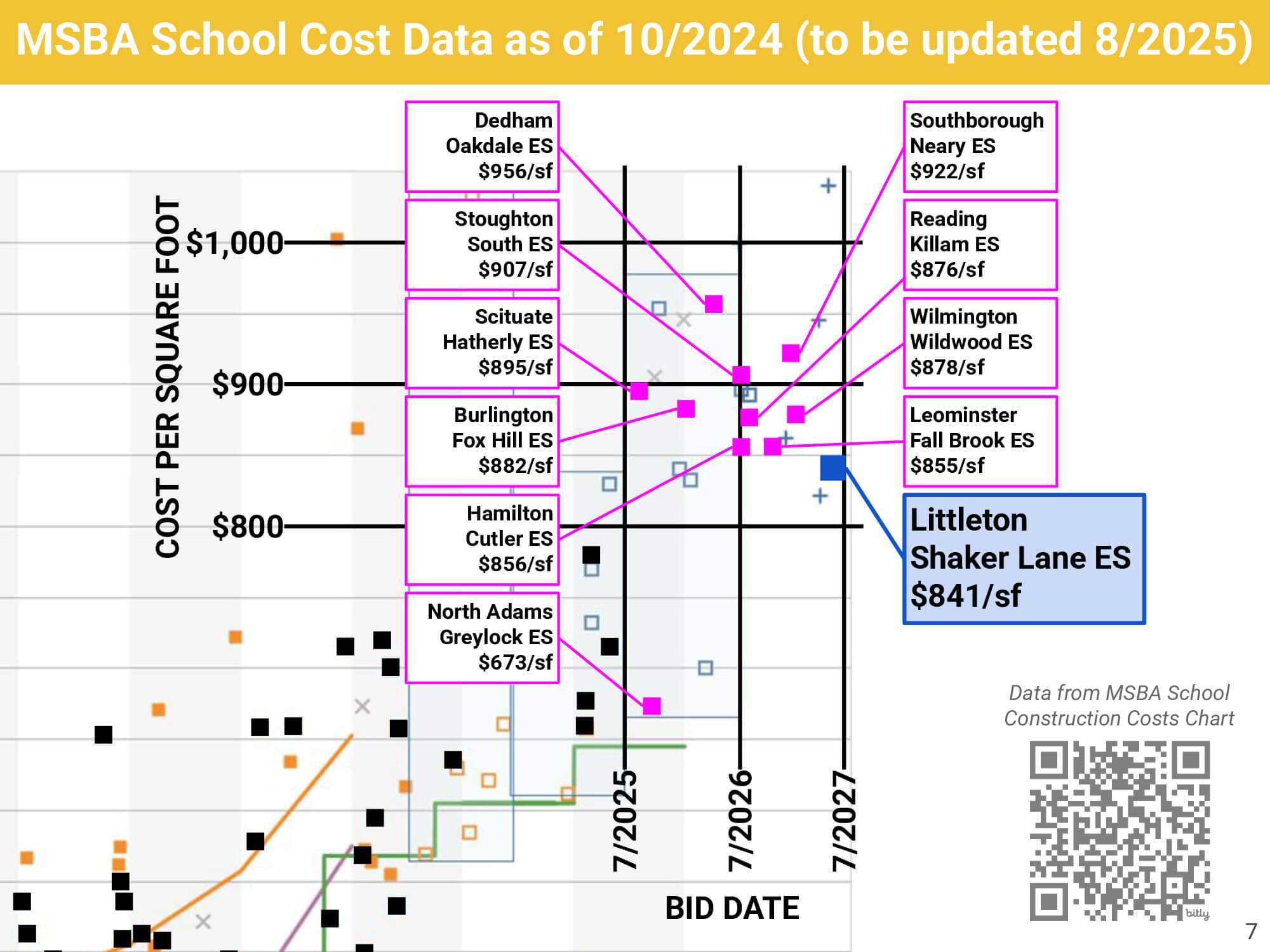
Littleton’s estimated cost per square foot is competitive across MSBA projects.
Among MSBA elementary school projects with a similar bid date, Littleton’s cost per square foot is at the low end, with an estimated $841/sf. Compare this to projects in Southborough ($922/sf), Reading ($876/sf), Wilmington ($878/sf), and Leominster ($855/sf). The price per square foot will only increase for future projects, as the trend line shows.
The Shaker Lane Building Project (aka the “YES” vote)
How much will a new Shaker Lane School cost?
This will be the most expensive project Littleton has undertaken to date.
The Project Team respects this and has been working diligently to reduce project costs and the resulting impact on taxpayers. The town will be working with a construction manager at risk (per Chapter 149A) who will ensure we do not exceed our budgeted total project cost.
| GUARANTEED total project cost: the final appropriation amount to be approved at Town Meeting; this is not the taxpayers’ cost | $98.1 M |
| GUARANTEED MSBA grant: increased by $8.8 M and ours for the taking | $38.2 M |
| Net project cost: | $59.9 M |
| Net bond amount: actual cost to Littleton’s taxpayers, reduced by $9.2 M | $50.7 M |
| Est. split tax impact, year 1 (FY30): “first year, worst year”—bill will decrease each year; based on the average FY25 Littleton home value of $694,868; bond term 20 years; reflects estimated future split tax rates; Debt Exclusion Stabilization fund pays 14.35% of debt over 20 years | $719.20 ($60/mo) |
Has anything been done to further reduce the costs to the taxpayer?
Littleton has reduced the net bond amount—the actual cost to taxpayers—by $9.2 million.
Littleton’s Select Board, Finance Committee and School Committee have estimated that $7.2 million can be appropriated into a School Building Stabilization fund by FY28. In addition, a $2 million bond premium—essentially a principal payment made immediately upon issuing the bond—further reduces the burden on taxpayers. The bond we’d issue is estimated at $50.7 million, reduced from $59.9 million.
Why do we need a new school?
Beyond solving the educational delivery issues with the old building, a new Shaker Lane School will allow the town to fully realize its educational plan.
Littleton is a highly rated school district because of the talented teachers and staff across our schools. We’ve asked so much of our Shaker Lane educators over the years, and they’ve delivered in spite of the limitations presented by their workspace. They, and in turn their students—our town’s youngest residents—deserve the right tools for 21st century learning. Investment in early education has a huge impact on the lives of students and on our town as a whole.
21st century learning
21st century learning is about flexibility and building “soft skills” (rather than focusing solely on technology, which can change so quickly). The top skills employers will be looking for when these students enter the job market are all soft skills such as communication, collaboration, cooperation, creativity, and critical thinking.
Instead of a traditional hallway, the reimagined Shaker Lane School transforms that same square footage into a central grade-level neighborhood. These “Learning Dens” are set up to foster social skills, build community, and allow for all kinds of different teaching and learning scenarios. The Dens provide ways for classrooms to interact with each other and with students from other grade levels. They allow for interdisciplinary learning where teachers work as a team to enrich the curriculum.
The current Shaker Lane School is undersized for the student population and its layout is not conducive to a modern educational program. Teachers and specialists are forced to work in siloes, duplicating efforts that could be shared in a larger space. Music classes are conducted in a small, windowless room that doesn’t allow for movement, as the curriculum dictates. Health and safety issues such as inadequate HVAC and limited access to bathrooms and clean water absolutely have an impact on day-to-day learning, and are distractions that must be addressed.
PACE (Personalized Academic & Comprehensive Education) Program
In the US, approximately 20% of students require additional support for things like learning disabilities, language learning, and behavioral issues, plus testing and evaluations to determine how to best help the students. In Massachusetts, the number is closer to 23% and at Shaker Lane School, it is over 24%.
This support comes in the form of one-on-one instruction and small group sessions. Most of these supports can’t be easily provided in a classroom setting, and some of them, like testing and evaluations, require quiet, private spaces.
To address this need, the reimagined Shaker Lane provides three learning centers (one for each grade K–2) for special education teachers to provide intensive support. 18 rooms for individual and small group support are scattered throughout the entire school; every classroom has direct access to a small group room, minimizing travel and reducing time students spend out of their classrooms.
The space constraints of the current Shaker Lane School uniquely affect its PACE learners. In some cases, students are receiving services at desks in hallways or in repurposed closets. Students with special needs may find it particularly hard to focus and thrive in such an environment. There is one conference room deep within the school where families and specialists meet to discuss Individualized Education Plans (IEPs). This reduces privacy for families and distracts students.
Is this school the right size for our needs?
The MSBA dictates a minimum square footage for schools in its program, which it calculates via its enrollment projection methodology. This ensures schools in the program meet state standards and provides for growth:
The MSBA, with the assistance of its consultant, developed a data driven enrollment projection methodology based on the modified grade-to-grade cohort survival methodology (“enrollment methodology”). The MSBA’s enrollment methodology generates a baseline enrollment projection using historic enrollment data (Department of Elementary and Secondary Education), birth data (Massachusetts Department of Public Health), female population data (US Census Bureau) and female population projections (University of Massachusetts’s Donahue Institute, “UMDI”).
Upon agreement of a design enrollment, the MSBA and the district continue to collaborate to further develop the total square foot of the proposed project as informed by the MSBA’s space guidelines and the district’s educational program. The MSBA grant will be informed in large part by the eligible square footage of the project which is needed to house the student population generated by the enrollment projection.
Littleton’s educational plan is so robust that the MSBA has been using it as a model. Every single extra square foot of space must be justified within the district’s educational plan to be approved for reimbursement by the MSBA via its grant. Very few square feet were considered not reimbursable.
Shaker Lane School Principal Michelle Kane and Project Architect Marylee Mercy go into this in detail on the 01460: On The Go! Podcast on September 4, 2025, starting at 12:16.
Were other sites in Littleton considered for the school?
Yes. 62 town-owned properties were considered as potential locations. All but one were eliminated due to issues such as inadequate size, inadequate access to roads or utilities, or the property is already earmarked for another use. Whitcomb Field by the Russell Street School / Littleton Middle School was evaluated in-depth and ultimately determined to be unsuitable for a new construction option.
What about renovating the existing school building?
The design team (SGA and their consultants) documented the existing Shaker Lane School and explored the feasibility of a renovation and expansion solution. Ultimately, this option was rejected for many reasons including:
- High costs for upgrades required by building codes (life safety, accessibility, restroom quantities, wall and roof performance, energy use, and more)
- The renovated portion of the building has layout constraints which would not optimally support the educational program
- No opportunity to improve the safety and efficiency of traffic flow
- Construction would be a major disruption to the occupants and neighbors
Was a combined Shaker Lane School and Russell Street School considered?
Yes. Early on in the project planning phase, the option to add Shaker Lane to Whitcomb Field on the Russell Street/Middle School campus was considered, and the option to combine SLS/RSS into one school was considered.
These plans were ultimately rejected because:
- the Russell Street neighborhood and the school campus could not safely handle the additional traffic load of 414 more students and their families
- combining the schools would result in over 800 students within one school building, which would feel oversized for Littleton (a school of this size is more common in an urban district)
- Russell Street School underwent an MSBA-backed major renovation as recently as 2010
The MSBA awarded Littleton a $38.2 M grant for a new Shaker Lane School because Littleton was able to adequately demonstrate need. If our project had included Russell Street School—which is currently sufficient in size, condition, and meets the needs of our educational plan—Littleton would likely not have been selected for the MSBA program, further delaying our ability to replace Shaker Lane School.
Littleton had a combined school years ago—a Junior-Senior High School once stood on the site of the current Littleton Middle School; its gymnasium remains as part of LMS. This school served students from 7th through 12th grades from 1957–2002. As the town grew and the school faced overcrowding, Littleton’s voters chose to divide this combined school into Littleton High School and Littleton Middle School. Littleton High School on King Street opened in 2002. For comparison’s sake, Littleton’s 2002 graduating class had 76 students. Littleton’s 2025 graduating class has 124.
After a new Shaker Lane School, what’s next? A new Russell Street School?
There are no current plans to replace or renovate Russell Street School, or any of the other schools in town.
Littleton’s three other schools—Russell Street Elementary, Littleton Middle School, and Littleton High School—are all in good shape and receive regular maintenance as part of the Town Budget.
Russell Street School underwent an MSBA-backed major renovation as recently as 2010.
I don’t have elementary-aged children, how does this affect me?
A new Shaker Lane School will benefit the community at large:
- LEED Silver certification aligns with Littleton’s long-term sustainability goals
- Accessible athletic fields will be graded after the current school is demolished (with a $3 million grant from the state) with ample parking nearby
- Controlled access will allow for community use of the building, playgrounds, and fields
- Separate car and bus loops—with new site access and a longer driveway—will greatly increase student safety and eliminate the traffic nightmare on Goldsmith Street at drop-off and pick-up
- The project will create jobs during construction, benefiting local contractors and suppliers
New spaces available for community use:
- Cafeteria (500 max capacity)
- Cafeteria Small Meeting Room A (8 max capacity)
- Cafeteria Small Meeting Room B (12 max capacity)
- Gym (700 max capacity)
- Max capacity for any single event is 700, limited by number of toilets
Part of what makes Littleton so special is that we care for others in our community. Building a new Shaker Lane School is the right thing to do, even if you as an individual are not directly impacted by the project.
Every $1 invested in early childhood yields $7 in longterm benefits to society.
What happens if we hit the code upgrade threshold while building a new school?
When repair costs to the existing school inevitably exceed $2.73 million (or 30% of the assessed value of the building) over the course of 5 years, a full code upgrade will be required.
The building inspector has the authority to not require the upgrades immediately, given that the existing school will soon be demolished.
When will I start to see higher taxes and when will it end?
The Town may issue short-term debt called Bond Anticipation Notes (BANs) during the construction of Shaker Lane. The amounts and timing of this debt is dependent upon the construction schedule and any reimbursements received from the Massachusetts School Building Authority (MSBA). These BANs require that only interest payments be made upon maturity, usually within one year after issuance. The increase to taxes is estimated to begin in 2026 through 2029 at approximately $400 on the average home.
Once the bond is issued, both principal and interest payments would be made, starting in FY30, with the tax impacts shown in the Shaker Lane School Tax Impact Calculator. Payments would decrease each year due to a reduction in annual interest payments. The final bond would mature in FY2049 and the exclusion would end.
What about tariffs and other future cost uncertainties?
The $98.1 M total project cost has price escalation and contingency built-in. This project budget is final; if costs come in higher down the road, measures will be taken to fit within the budget. The town will not be asked for additional funding.
Littleton will be working with a construction manager at risk (per Chapter 149A) who will ensure we do not exceed our budgeted total project cost (GMP, or guaranteed maximum price). Any budget overage will be the responsibility of the construction manager at risk, who also builds in contingency and carries insurance for such a situation. The GMP guarantees that the project will not cost one penny more than $98.1 M.
Code Upgrades to the current Shaker Lane School (aka the “NO” vote)
How much will code upgrades to the current Shaker Lane School cost?
The projected bond of $51 million to finance these upgrades—not a renovation—is higher than the bond for building a new Shaker Lane School ($50.7 million).
| Estimated cost of code upgrades: final cost may be higher; will worsen space issues and require modular classrooms | $44 M |
| Estimated cost of modular classrooms: 22 modulars needed for all 414 students during repairs | $12 M |
| Estimated net project cost: | $56 M |
| Estimated net bond amount: estimated cost to Littleton’s taxpayers, reduced by $5 M by the Town | $51 M |
| Est. tax impact, year 1: “first year, worst year”—bill will decrease each year; based on the average FY25 Littleton home value of $694,868; bond term 10 years | $1,494.77 ($125/mo) |
| PLUS a new Shaker Lane School: reflects 10 years of cost escalation compounded at a 5% annual increase | $161.5 M |
What’s wrong with Shaker Lane?
Education
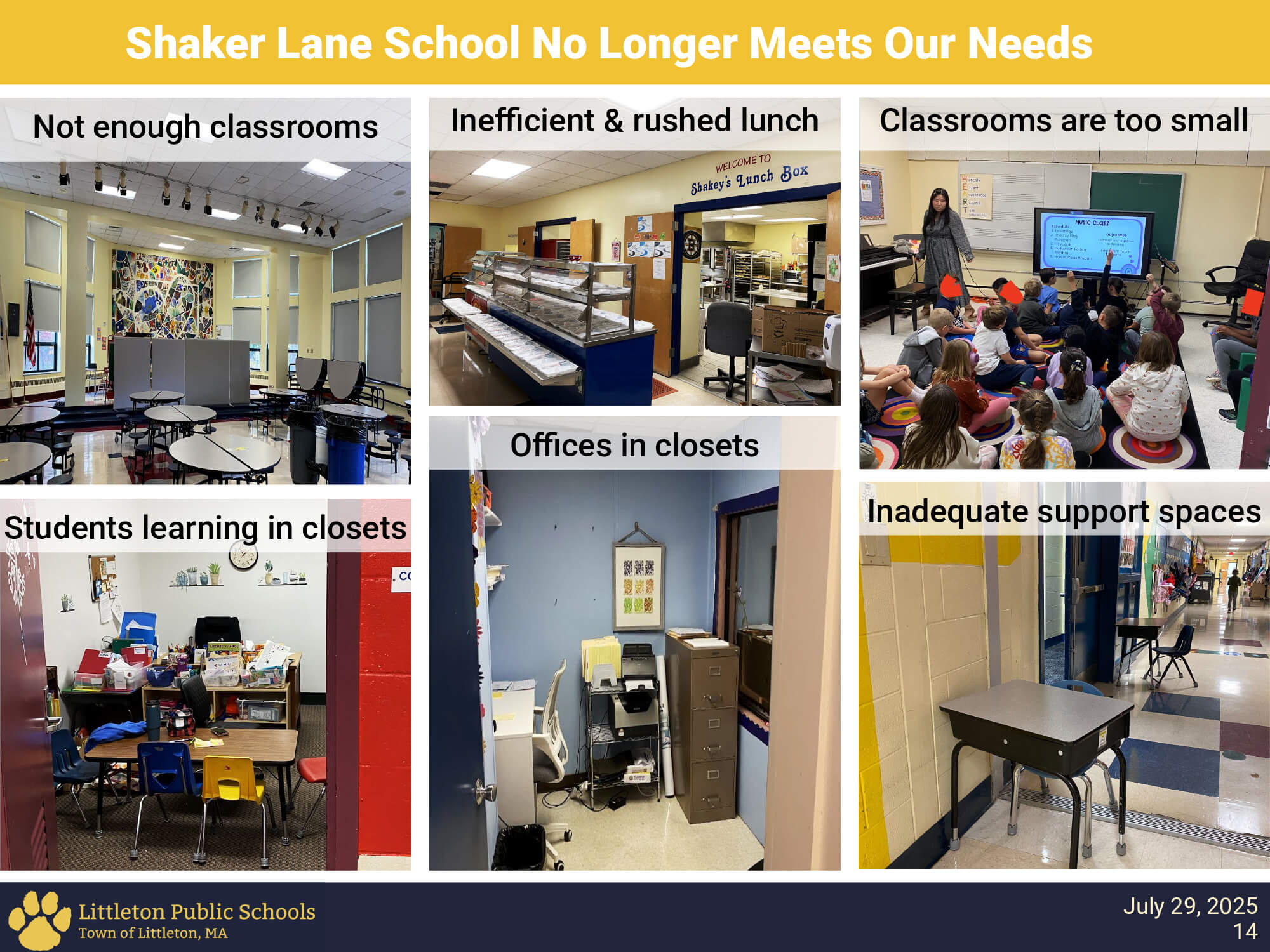
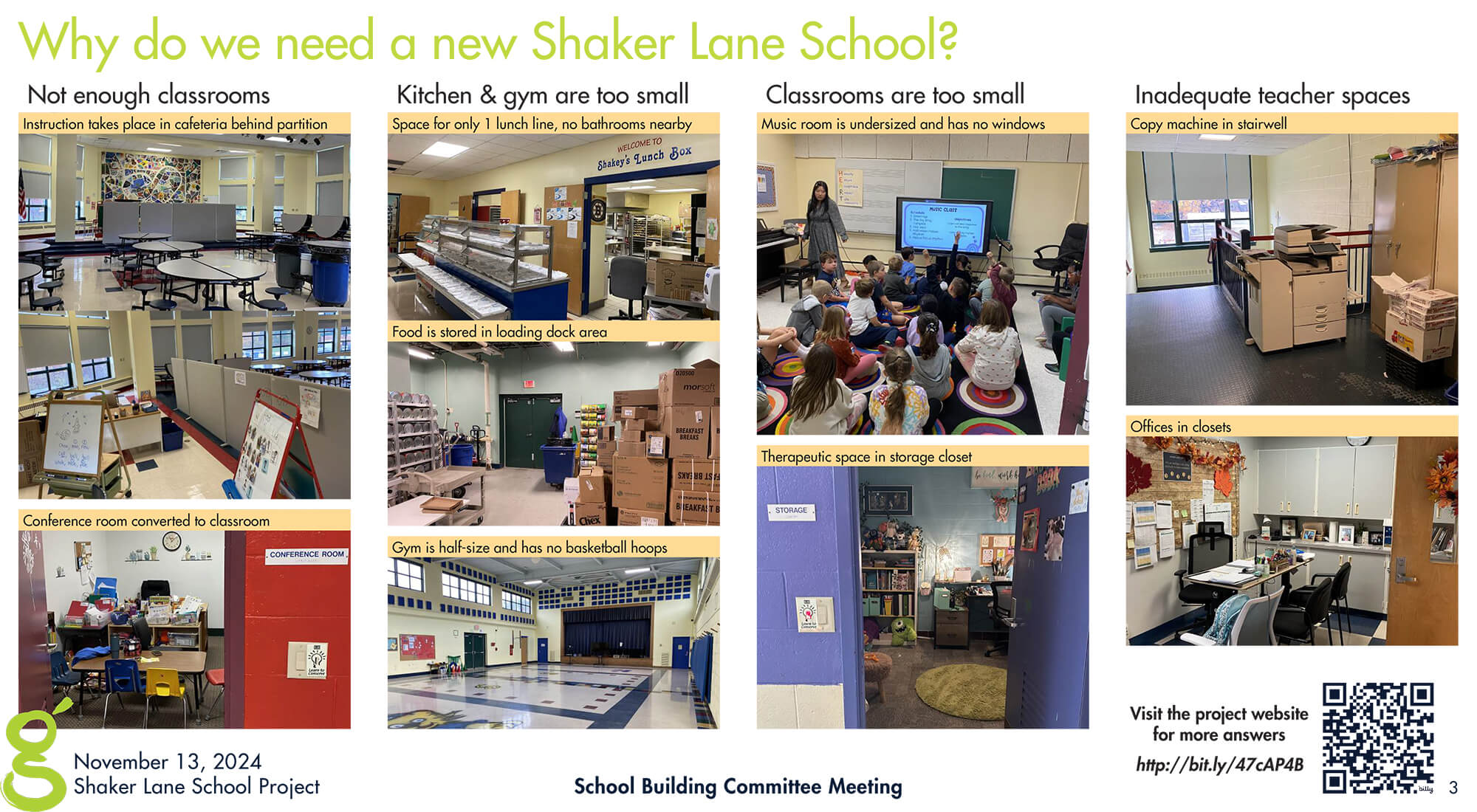
- There are no spaces for private instruction or collaborative small groups; students frequently receive support services in hallways and re-purposed storage closets.
- Classroom layouts are not conducive to 21st century instruction. They do not allow for standard technology devices such as interactive white boards or speaker systems.
- Several instructional spaces and offices lack windows or natural light.
- There is no provision for outdoor learning.
- There is not enough storage space. Many materials are stored in the corridors. The school stage is used as storage and a teacher work area.
Building Systems
- The building lacks adequate cooling, resulting in some interior temperatures regularly exceeding 85–90°F.
- There is little to no insulation in the existing classroom wing exterior envelope.
- The roof, back-up generator, boilers, and classroom heating units are at the end of their lifespans.
- The electrical system is at capacity.
- Drinking water is available only at a limited number of drinking and bottle filling stations. There is no access to water in the gym.
- There are ongoing issues with septic odors and the source has yet to be found.
- There are not enough adult bathrooms distributed throughout the school.
Safety & Accessibility
- The site circulation does not have clear separation of buses, cars, and pedestrians.
- There are no sprinklers for fire protection.
- Many elements are not ADA compliant, including play equipment, parking, entry doors, toilet rooms, signage, doors/door handles, handrails, and plumbing fixtures.
This list is not exhaustive.
Will code upgrades fix the problems with the current Shaker Lane School?
If the Shaker Lane School Building Project fails to pass Town Vote, the town will need to invest millions in repairing the existing building—this is NOT renovation. Many critical systems are at or beyond their expected lifespan, and Littleton will be 100% responsible for repairing or replacing systems as they fail. Emergency repairs will negatively impact student learning, and school closures could spell disaster for caregivers and families.
Code upgrades do not address the root of the problem.
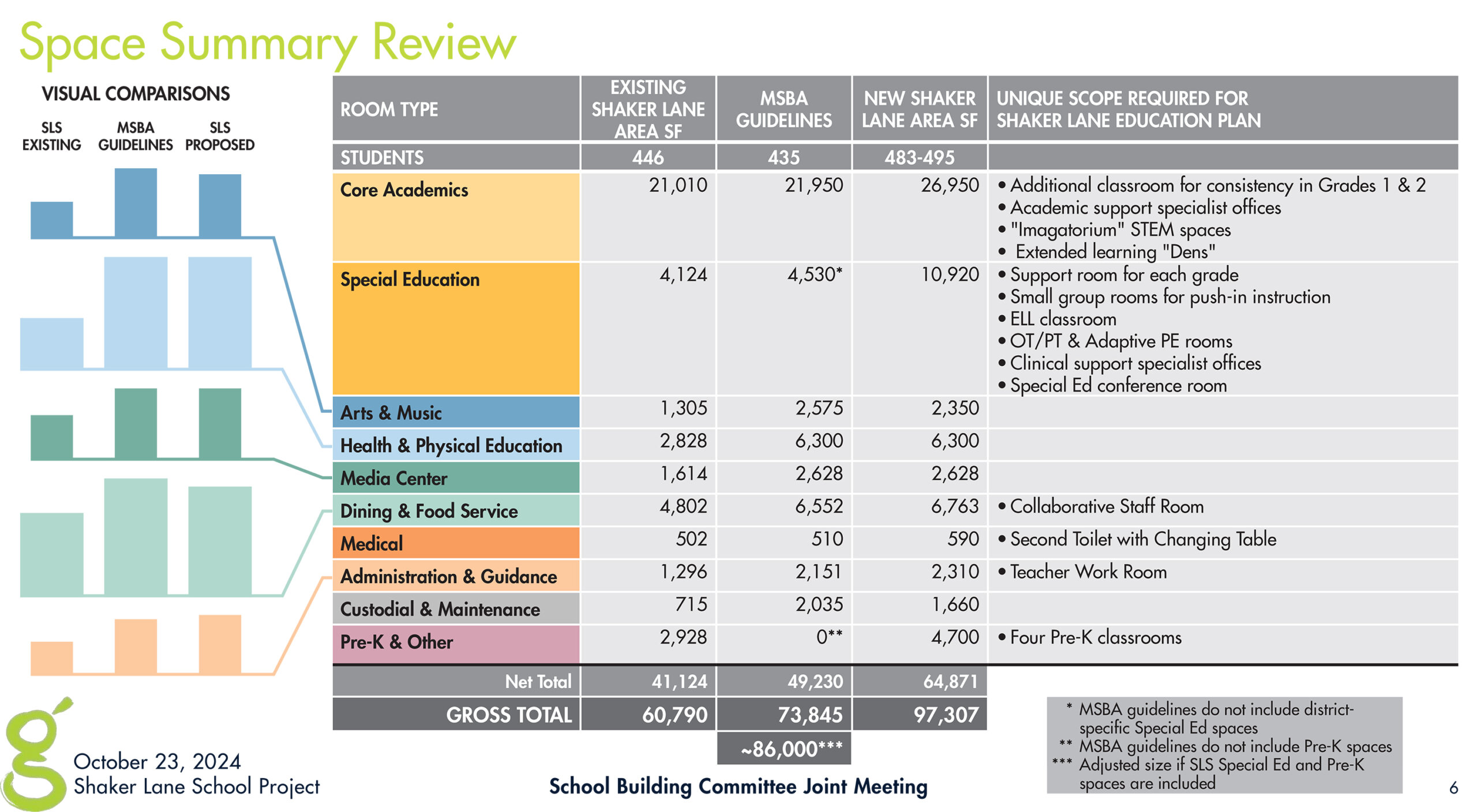
The current school building is roughly two-thirds the size it should be to serve Littleton’s growing population (per MSBA guidelines), and code upgrades will not solve this problem.
The MSBA has determined the scope required to meet the Shaker Lane Educational Plan. The Space Summary Review below (page 6 from the School Building Committee Joint Meeting on October 23, 2024) provides a visual comparison between the SLS Existing square footage vs and MSBA Guidelines.
An additional $6 million will need to be spent to provide modular classrooms that will take up most of the current outdoor play space and become a logistical nightmare for students and staff alike. During code upgrade repairs, this will jump to $12 million for 22 modulars—enough for the entire school.
The traffic issues on Goldsmith Street at drop-off and pick-up will continue.
The SLS Proposed square footage has been reduced to 97,232 square feet since the School Building Committee Joint Meeting in October 2024—see page 136 of the Preferred Schematic Report.
Code upgrades will actually reduce learning space.
Many required upgrades will require pushing into educational or office space, which is already at a premium in the current Shaker Lane School. For example, an up-to-code elevator is substantially larger than the existing lift at Shaker Lane; surrounding rooms will have to get smaller to accommodate it. Enlarging a bathroom to meet ADA accessibility standards will mean cutting space from adjacent classrooms.Code upgrades are a waste of town resources.
A NO vote will send the Project Team back to the drawing board—literally—resulting in years of duplicated work (and costs) as they work to get us back into the MSBA pipeline with no guarantee of a future grant.
The new school was custom designed to support Littleton’s educational plan, a document—lauded for its thoroughness—that took time and resources to complete. Many of the goals of this plan are simply impossible to achieve within the confines of the current school building.
What upgrades are included in the $44 million estimate?
The $44 million estimate includes all upgrades required by code (accessibility/elevator, life safety (sprinkler and fire alarm system plus additional hydrant(s)), kitchen/health code, plumbing fixtures, electrical upgrades, roof replacement, structural reinforcements, window/door replacements, playground repairs/partial replacement, etc. Any work that disturbs materials with asbestos or lead includes the cost of abatement, but any hazardous materials that are not disturbed would be left in place.
The current $44 million estimate does not include getting the building to meet current energy codes. Meeting energy codes would require substantial modifications to all exterior walls, windows, doors, and the roof.
The Shaker Lane School Triggering Report walks through possible code upgrade “triggering” scenarios.
Why is the estimate not a firm number?
These costs are included as a $/sf amount from the project’s professional estimator; no line item estimate has been done as that was not in the scope of the SLS feasibility study.
The Shaker Lane School Triggering Report walks through possible code upgrade “triggering” scenarios.
Why is the building code upgrade bond estimated at 10 years vs 20 years for the new school?
Building code upgrades—such as repairs to boilers, HVAC, electrical, plumbing, the roof, the fire alarm panel, etc.—simply shore up an aging building that we know is not adequate for our children’s educational needs, per the MSBA. Since the estimate to re-enter the MSBA program is 5–7 years, a 10 year bond would prevent the Town from having overlapping debt when the project comes around again for approval.
How close are we to triggering code upgrades?
When repair costs inevitably exceed $2.73 million (or 30% of the assessed value of the building) over the course of 5 years, a full code upgrade will be required. This will cost the town an estimated $44 million just to shore up a failing building (estimate is from July 2024, actual cost may be substantially more).
None of this spending will be reimbursed by the state; the burden of maintaining the current school building will be fully on the town and its taxpayers. In a time of rising costs, this spells trouble.
Shaker Lane School is beyond its life expectancy. Fixes to the fire panel alone may trigger this full code upgrade as a fire suppression system would also need to be installed. Boilers breaking down in the dead of winter could prove disastrous, both financially and logistically—and the risk of this happening increases every year.
Repairs made in the last 5 years amount to just under $300k, roughly 11% of the $2.73 million threshold. It’s worth noting that this number represents a collection of small needed repairs over time—the large list of expensive failing systems has yet to be tackled.
Why not just install modular classrooms?
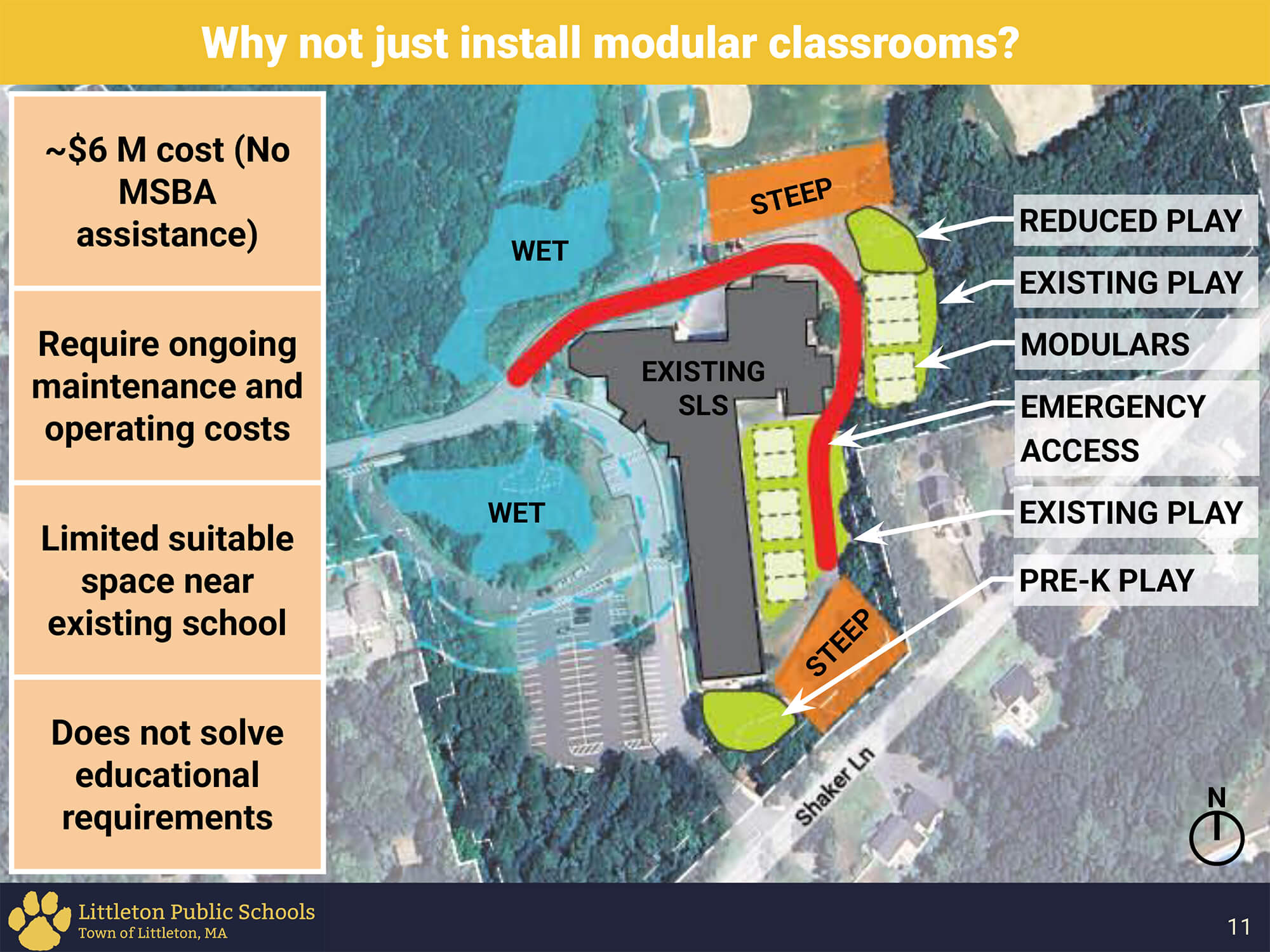
If Littleton votes NO this fall, Shaker Lane School would remain ~2/3 the size it should be (according to MSBA guidelines).
11 modular classrooms would have to be installed—at $6 million—to make up the space difference, but they will not solve the problem:
- The existing electrical system at Shaker Lane is not sized for expansion or reuse in a major renovation; utility connection costs for the modulars would most likely trigger the code upgrade as they can’t use temporary electric
- A code upgrade would require even more modulars at $12 million to house the student body during construction
- Each modular would eliminate outdoor play space
- Modulars are not suitable for very young students or students who require additional supports
- Modulars do not solve educational delivery issues (ex: kitchen, gym, library, student support spaces)
- Modulars have installation, operational and maintenance costs
Can we move Pre-K to the Shattuck Street building to free up space at Shaker Lane?
It is crucial that Pre-K remains with the K–2 student population, as many service providers are shared between grades (including Pre-K) and travel time would mean lost service time. Having Pre-K students in the same building as K–2 also allows for key Kindergarten readiness steps such as visiting the cafeteria, the gym, and other shared sites in school. Physical proximity also allows Pre-K and Kindergarten teachers to collaborate to make sure students are ready for Kindergarten.
The Shattuck Street building is also facing the same code compliance tripwire that Shaker Lane is—this was one of the major reasons the town proposed selling it to be developed into deeply affordable housing. Littleton would be faced with pouring cash into two buildings with tons of issues.
What about tariffs and other cost uncertainties?
Code upgrades to the existing building will have no budget protections and costs could balloon significantly due to tariffs, scarcity of replacement parts and other factors.
What if the town fails to pass the bond to fund code upgrades?
If Littleton votes NO on the Shaker Lane School building project and NO on the bond to cover code upgrades to the existing building, then Shaker Lane School would be out of compliance with state building code. The school could be condemned and forced to close until code upgrades can be made.
In this scenario, students would have to be relocated to different schools. This could include transporting students to other towns—wherever there may be space. This could go on indefinitely until the voters approve funding for code upgrades. In the mean time, families may start moving away, potential new residents may choose other towns (several neighboring towns have new schools), and property values will plummet. A smaller population in the town would mean a higher tax burden on individuals so the likelihood of this funding ever being approved goes way down.
In short, the prosperity Littleton enjoys would be in peril for years to come.
Town Meeting and Town Election
What is Town Meeting?
Adapted from The Citizen’s Guide to Town Meetings, edited and published by the Office of the Secretary of the Commonwealth.
What is a Town Meeting?
A Town Meeting is both an event and an entity. As an event, it is a gathering of a town’s eligible voters, and is referred to as “the Town Meeting.” As an entity, it is the legislative body for towns in Massachusetts, and is referred to simply as “Town Meeting.” So you may say, “I went to the Town Meeting. Town Meeting approved the budget.”
Do cities have Town Meetings?
No. A city’s legislative body is called a city council or a board of aldermen. Citizens do not govern a city directly.
What’s the difference between cities and towns? Size?
Municipalities decide whether to have a city or town form of government. Size is one factor in the decision. Towns with less than 12,000 inhabitants cannot adopt a city form of government.
Do all towns have Town Meetings?
Most but not all towns have Town Meetings. A few towns are governed by town councils. In sum, no cities have Town Meetings and most towns do have Town Meetings.
What does Town Meeting decide?
Town Meeting decides three major things:
- It sets the salaries for the elected officials.
- It votes to appropriate money to run the town.
- It votes on the town’s local statutes, which are called by-laws.
What’s a moderator?
Generally, a moderator’s job is to run the Town Meeting. Specifically, the moderator declares the outcome of all voice votes. Some towns have detailed by-laws governing Town Meeting procedure. Other towns leave a lot of discretion to the moderator. Moderators are usually elected at the Town Election at which voters go to their regular polling places. The term of office is one or three years. When the elected moderator is absent, a temporary moderator may be elected at the Town Meeting.
What’s a selectman or selectwoman?
Selectmen are a town’s executive officers. Voters elect them to the Board of Selectmen, which usually has three or five members. Selectmen are authorized to call a Town Meeting provided that they have posted a warrant. In small towns, the Board of Selectmen runs the town and supervises town workers. In larger towns, the Board of Selectmen picks and supervises a person, who, in turn, runs the town and supervises town workers. Depending on the town, that person has various authority, duties, and title. That person is known as the town manager, town administrator, executive secretary, or administrative secretary.
What does the town clerk do?
At the Town Meeting, the clerk records all votes and takes minutes. Town clerks are elected or appointed. In the event of all of the selectman/selectwomen resigning, the town clerk is authorized to call a town meeting.
What is a town counsel?
The town counsel is a lawyer who either works for the town as an employee, or is a private lawyer who counts the town among his or her clients. The town counsel often prepares the warrant (the Town Meeting’s agenda). During the Town Meeting, the town counsel answers legal questions that come up. He or she is appointed by the selectmen.
What does the finance committee do?
The finance committee prepares the budget in the months before the annual Town Meeting starts. It also prepares financial articles (which are agenda items). Its recommendations are advisory. In some towns, the committee is known as the warrant committee or the advisory committee. Depending on a town’s by-laws, members of the finance committee are appointed by the selectmen or moderator, or elected by voters or the Town Meeting. In many towns, the finance committee’s report is distributed to all residences.
What’s the difference between annual and special meetings?
Each town must hold an annual Town Meeting. Additional Town Meetings are called special meetings. They may be called as many times during the year as necessary.
When are Town Meetings?
Annual Town Meetings, unless otherwise provided by special law or charter, must be held in February, March, April or May. The Board of Selectman may delay the annual meeting, but it must be completed by June 30th.
What’s a warrant?
The warrant lists a meeting’s time, place, and agenda. A warrant is also known as a warning. A Town Meeting’s action is not valid unless the subject was listed on the warrant.
What are articles?
Articles are items on the warrant. Appropriations for each town function or department may be in separate articles. Or one article on the warrant may propose appropriations for all necessary town expenses.
What is the quorum for a Town Meeting?
The minimum number of voters who may conduct business is established by the individual town’s by-laws. The quorum in some towns is zero; if only a single citizen appears, the Town Meeting may start and conduct business.
Who may attend?
Any member of the public may attend a Town Meeting.
Who may speak?
All of a town’s registered voters may speak in a Town Meeting. Non-voters may speak at the discretion of the moderator or Town Meeting.
Who may vote?
The town’s registered voters may vote at Town Meeting.
How do I speak in debate?
- If you wish to speak, stand up and wait for the moderator to acknowledge you. When the moderator acknowledges you, state your name, your precinct if you know it, and your address.
- Speak about the topic being discussed. Don’t speak about a previous topic (unless there is a motion to rescind or reconsider).
- Make your comments to the moderator, not to the Town Meeting or individual Town Meeting Members. For example, do not say, “I have something to say to the Town Meeting,” or “Mr. Smith, you said something as a Town Meeting Member that I want to respond to.” Instead, say something like, “Mr. Moderator, these are my thoughts on this article.”
- You may attack a previous speaker’s argument, but do not attack a previous speaker. For example, do not say, “The previous speaker is dead wrong.” Instead, say something like, “I disagree with the argument we just heard.” Try to avoid referring to previous speakers by name. For example, try not to say, “I agree with Mr. Jones’ argument.” Instead, say something like, “I agree with the argument that we can afford this budget item.”
- Since you make your comments to the moderator, you may not directly debate or ask questions of a previous speaker. For example, do not say, “Mr. Johnson, you say that we should make another exception to the zoning law. I’m asking you: When do we draw the line and stop making exceptions?” Instead, say something like, “Mr. Moderator, we have heard the argument that we should make just one more exception to the zoning law. But I say it’s time to stop making exceptions.”
If I’m not familiar with making motions, how do I make one?
Rather than make a motion that may require the moderator to untangle and decode it, stand up and ask the moderator from the floor how to make a motion to achieve what you want to do.
How do I call for a vote?
Move the previous question, which means to call for a vote. Under the by-laws of many towns, you must make certain motions, such as those involving money, in writing.
How Town Meetings Work (and How To Vote)
by TJ Donegan
Littleton town meetings are fairly straightforward, even if you’ve never been to one before.
Every meeting has a list of articles in a Town Meeting Report that are published before the meeting, such as this one. They are available on the town’s Town Meeting Documents website. You’ve likely also received these in the mail, so they’ll look familiar. The town goes through the articles, votes are tabulated on each motion, and then motions pass or fail.
The basic order of a town meeting:
- The meeting begins when the moderator calls it to order. The moderator is in control of the meeting and will be the one who handles the flow of motions, explains the process for each vote, and has to recognize you at the microphone before you should speak.
- The moderator, select board and various departments will go through the articles in order. The article order may change from the Town Report you’re sent in the mail, so be sure to arrive on time if possible.
- For each article, information will be presented by a speaker. This typically is just what is in the Town Report, though added info and handouts may be given at the meeting if things have changed.
- Before voting on each motion, there will be time for public comment. Anyone who wants to comment usually can line up at the microphone and will get three minutes to speak each.
- After enough comments are given, the moderator motions for a vote. Everyone votes on their personal voting machine and then the votes are displayed on the screen. Some votes require a simple majority to pass, some require 2/3rds. The moderator will announce the result and then we move on to the next article.
- Voting is now done electronically in town meetings. You will get a small voting machine when you get to the meeting, you’ll just need to check in and provide your name and street.
- If you’ve voted on all the articles you care about, you can leave early. You can also arrive at any time, but you can not vote on an article that has already passed or failed. Each motion only gets one vote and it passes or fails, so it’s very important everyone who supports this plan be at the meetings to vote.
Tips for attending a town meeting:
- Meetings are live-streamed on LCTV so you can follow along or watch previous meetings you may have missed. It’s good to browse through a video of a past meeting for a few minutes, like this one, to get a feel for how meetings operate.
- Town meetings are typically held in the Middle School gymnasium or the High School.
- Town meetings are LONG. They are exhausting. The gym gets stuffy. Especially for votes with lots of turnout, it is normal for meetings to run 3–4 hours. If the article you care about the most is at the end, plan to be there until your article is voted on. Bring water or a snack.
- If you have to arrive to the meeting late, that’s okay. As long as you’re there to vote before the article you’ll be allowed to vote on it. Just don’t rely on the live stream to tell you when to get there, it often runs a few minutes late.
- Every voting age resident present gets a vote. If you are able to bring more than one person with you, that’s extra votes for us!
- Public comment before contentious votes can stretch for over an hour. Every person gets three minutes and they tend to use the full three minutes, so 20 people who want to speak adds up. Be patient and be ready to vote when the moderator moves to a vote (which may happen while people are still in line to speak).
- You should get up to comment if you feel inclined. Speaking at a town meeting can feel intimidating but it’s not that bad. These are just your friends and neighbors, everyone wants to hear from you. Everyone’s opinion counts. You may want to write a few notes down on paper or your phone so you remember what you want to say when you get up there.
- Even if someone in front of you makes a similar point to yours: stay in line. Hearing the same perspectives multiple times can help sway people in the room. You don’t need to use your full three minutes, even reminding people of arguments made earlier can help and when the ratio of comments is overwhelmingly positive or negative that can help neutral people present to make up their minds. If you support this plan, speaking at the meeting is a great way to help.
What are we voting on?
A debt exclusion requires two votes. On October 28, a FY26 Fall Special Town Meeting will vote to authorize the Town to issue the bonds necessary to construct the Shaker Lane School. Approval will require a 2/3 majority vote at Town Meeting. A second vote will take place shortly after Town Meeting, at a town election on November 1, to ask the Town to raise the amount needed outside the Levy Limit to make principal and interest payments on a 20-year bond.
Littleton must vote YES on October 28 and November 1 for the Shaker Lane School Building Project to pass.
If the project does not pass Town Vote, the cost of building code upgrades to the current school ($50+ million) will also require a debt exclusion. A projected bond of $40.5 million to finance these upgrades—not a renovation—will have a higher first year tax impact ($1,187) than building a new Shaker Lane School ($859).
Select Board Chair Karen Morrison, Finance Committee Chair Steve Venuti, and School Committee Chair Justin McCarthy go into this in detail on the 01460: On The Go! Podcast on September 10, 2025, starting at 1:04.
What is Special Town Election?
A debt exclusion requires two votes. On October 28, a FY26 Fall Special Town Meeting will vote to authorize the Town to issue the bonds necessary to construct the Shaker Lane School. Approval will require a 2/3 majority vote at Town Meeting. A second vote will take place shortly after Town Meeting, at a town election on November 1, to ask the Town to raise the amount needed outside the Levy Limit to make principal and interest payments on a 20-year bond.
Littleton must vote YES on October 28 and November 1 for the Shaker Lane School Building Project to pass.
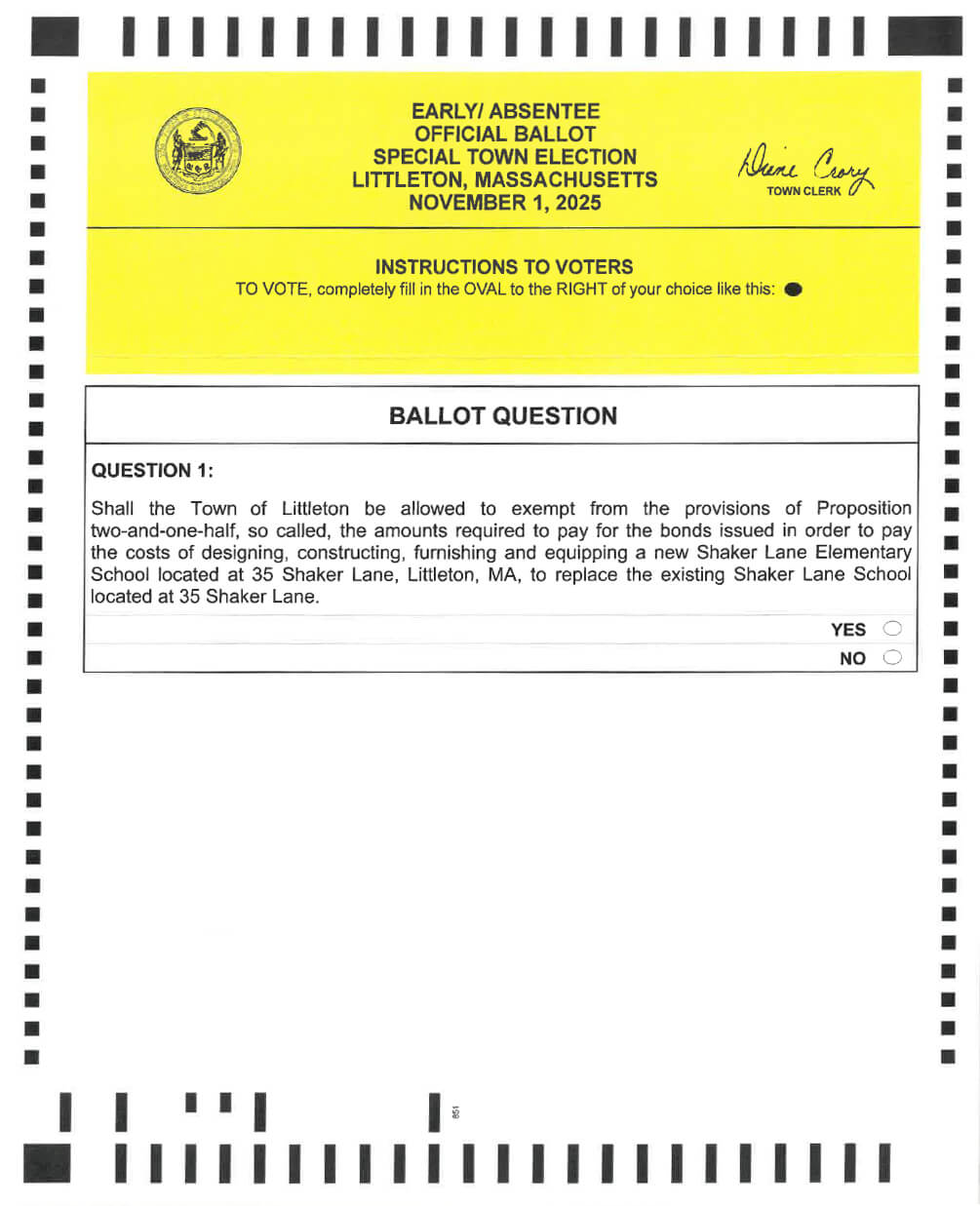
The Town of Littleton is holding a Special Town Election based on MGL. The vote “Shall the Town of Littleton be allowed to exempt from the provisions of Proposition two-and-one-half, so called, the amounts required to pay for the bonds issued in order to pay the costs of designing, constructing, furnishing and equipping a new Shaker Lane Elementary School located at 35 Shaker Lane, Littleton, MA, to replace the existing Shaker Lane School located at 35 Shaker Lane.” This is step two of the vote. The first step is at the Special Town Meeting that is taking place on Tuesday, October 28th.
Anyone that requested an Early mail-in ballot in the spring will be receiving the November 1st ballot in the mail within the next two weeks. Anyone that did not request an Early mail-in ballot last spring may do so in writing with the voter’s signature to the Clerk’s Office 37 Shattuck Street Littleton, MA 01460, until Monday October 27th at 5pm. Absentee ballots may be requested in writing with the voter’s signature to be mailed until Monday, October 27th at 5pm or in person until Friday, October 31st at Noon.
Please find the sample ballot here.
Any questions, please contact the Clerk’s Office at 978-540-2401 or by email at [email protected].
What is a Proposition 2½ debt exclusion?
Proposition 2½ allows a community to raise funds for certain purposes above the amount of its levy limit or levy ceiling. A community can assess taxes in excess of its levy limit or levy ceiling for the payment of specified debt service costs. An exclusion for the purpose of raising funds for debt service costs is referred to as a debt exclusion. A debt exclusion requires voter approval. The additional amount for the payment of debt service is added to the levy limit or levy ceiling for the life of the debt only. Unlike overrides, exclusions do not become part of the base upon which the levy limit is calculated for future years.
Reimbursements such as state reimbursements for school building construction are subtracted from the amount of the exclusion.
A debt exclusion is effective even in the rare case when the exclusion would bring the community’s levy above its levy ceiling and requires a two-thirds vote of the Select Board in order to be presented to the voters. A majority vote of approval at a ballot vote is required.
Questions presented to exclude a debt obligation must state the purpose or purposes for which the monies from the debt issue will be used.
What votes are necessary for a debt exclusion?
A debt exclusion increases the amount of property tax revenue a community may raise for a limited or temporary period of time in order to fund specific projects. The amount of an exclusion may be raised in addition to the community’s levy limit. It does not increase the community’s levy limit nor become part of the base for calculating future years’ levy limits.
An exclusion may be used by a community to fund capital spending whether the spending is financed by borrowing (debt exclusion) or within the annual budget (capital expenditure exclusion).
There is no limitation on the number or dollar amount of exclusions.
A debt exclusion requires 2 votes. Town Meeting will vote to authorize the Town to issue the bonds necessary to construct the Shaker Lane School. This would require a 2/3 vote at Town Meeting. This vote is scheduled to occur at the FY26 Fall Special Town Meeting on October 28, 2025.
A second vote would take place shortly after Town Meeting on November 1, 2025, to ask the Town to raise the amount needed, outside the Levy Limit, to make principal and interest payments on a 20-year bond. Each year, the Town would add to the total amount needed for that year to pay the annual principal and interest payment to that year’s Levy Limit. If no debt exclusion were used, the Town would need to absorb the costs of those annual payments within the Levy Limit. Based upon the size of the project, it is the Town’s position that raising such funds within the Levy would limit the availability of funds for Town operations and other projects.
A “YES” vote would allow the Town to levy the additional taxes needed to repay the money it borrows to construct a new Shaker Lane School.
A “NO” vote would not allow the Town to levy additional taxes to construct a new Shaker Lane School.
Has the Town funded projects using debt exclusions in the past?
It has been several years since the Town has funded projects using a debt exclusion. Previous projects funded this way were:
- FY2009 – Middle School construction
- FY2011 – Police Station construction
- FY2012 – Russell Street School renovation
- FY2013 – Russell Street School Track construction
The Finance Committee has made additional payments towards the town’s debt, further reducing the burden on taxpayers. By FY30—when payments on the Shaker Lane School bond will begin—all debt associated with these projects will be fully paid.
What happens if Littleton votes NO?
If we vote NO, we will be throwing away a $38.2 million grant, as well as over $1 million in project costs thus far. There is no guarantee we will be invited back into the MSBA program if we do not vote YES this fall.
The cost of building a new Shaker Lane School will increase. Recent building construction inflation rates have trended at 5% annually. A $99,164,951 project cost of today becomes $161,529,256 in 10 years.
If the decision is made not to construct a new Shaker Lane School at this time, the Town and its taxpayers must maintain the aged building until a new one can be built.
Modular classrooms would need to be purchased and installed to address space issues (estimated at $6 million), which would all but eliminate outdoor play space.
Any work done in the building exceeding approximately $2.7 million would require the Town to bring the building up to current code (estimated at $44 million), and enough modulars would be needed for the entire school population during construction ($12 million). MSBA grant funding would not be available to help offset these costs.
The projected bond of $51 million to finance these upgrades—not a renovation—is higher than the bond for building a new Shaker Lane School ($50.7 million).
Can the Town assist me with tax relief?
The Town offers several programs to assist residents that may qualify for tax relief.
Information on these programs can be found on both the Assessor’s and Elder and Human Services department’s webpages.
Case Studies
Burlington — following the MSBA process even without an MSBA grant
Burlington will be pursuing a debt exclusion to pay for its new $334.3 M High School, without any MSBA contribution. However, the town is still choosing to follow the MSBA process to ensure a quality, affordable, and sustainable school.
Burlington Public Schools has applied to the MSBA Core Program for its High School for thirteen years without acceptance, with no guarantee if or when it will be approved. The town is moving forward with their Burlington High School project without MSBA funding as they say it’s “not practical for the District to wait on uncertain MSBA funding while costs rise, the building deteriorates, and student needs go unmet.”
The District’s reasoning:
- MSBA rarely funds two major projects in one district at the same time, and Burlington’s Fox Hill Elementary is currently in the grant program.
- Overcrowding is a key MSBA criterion; the high school was built for 2,000 students but enrollment is under 1,000.
- Construction and borrowing costs continue to rise while the aging building becomes more expensive to maintain.
- Acting now allows the community to address critical facility needs and invest in a long-term, cost-effective solution.
Here’s a quick side-by-side comparison of Littleton and Burlington’s projects:
| Town | Littleton | Burlington | Burlington |
| School | Shaker Lane Elementary School | Fox Hill Elementary School | Burlington High School |
| Project type | New Build | New Build | Renovation & Addition |
| Enrollment, grades served | 435, Pre-K–2 | 325, K–5 | 1100, 9–12 |
| Estimated square footage | 97,232 | 91,000 | 205,741 |
| Estimated net project cost | $98.1 M | $100 M | $334.3 M |
| Estimated MSBA contribution | $38.2 M | $30.9 M | $0 |
What does this mean for Littleton?
Burlington’s example perfectly illustrates the value of the MSBA process—even without a grant.
Besides the financial benefits of an MSBA grant, working with the MSBA ensures a right-sized school tailored to our town and its growing population. The reimagined Shaker Lane School is designed for 21st century learning, flexibility, sustainability, and affordability.
In the MSBA process, the District works together with its design team, Owner’s Project Manager, and local stakeholders to develop, evaluate, and select a design that supports the town’s educational objectives and needs. The MSBA wants to help as many communities as possible improve their schools, and that can only be done by making sure the projects that receive MSBA money are doing so in a fiscally responsible manner.
The new Shaker Lane School will be LEED Silver certified, all-electric, solar-ready, and will include a geothermal ground source heat pump system. The MSBA has established several sustainable green programs for all MSBA-funded projects, with an increased emphasis on reducing energy consumption and improving indoor air quality.
The MSBA also requires and pays for the entire cost of building commissioning for all MSBA-funded projects to ensure that these buildings operate efficiently and as designed.
The MSBA, which has a dedicated revenue stream of one penny of the state’s 6.25-percent sales tax, is collaborating with municipalities to equitably invest in finding the right-sized, most fiscally responsible and educationally appropriate solutions to create safe, sound, and sustainable learning environments.
The MSBA has made more than $18.0 billion in reimbursements to cities, towns, and regional school districts for school construction projects. Instead of waiting years for reimbursement, districts now receive payments from the MSBA as costs are incurred, usually within 15 days of submitting a request through the MSBA’s online Pro-Pay System.
Groton — a new elementary school, then town budget trouble?
The Groton-Dunstable school district completed its new Florence Roche Elementary School in 2024, with $25.8 M of construction costs reimbursed by an MSBA grant. In May 2021, Groton-Dunstable voters had authorized a debt exclusion to pay for the school.
“You can see that we’re not building the Taj Mahal,” Marlena Gilbert, chair of the Groton-Dunstable Regional School District Committee said, pointing to the cost and size of comparable school projects. “We’re building a school that will be able to educate our kids for 50 years or more.”
Here’s a quick side-by-side comparison of Littleton and Groton-Dunstable’s projects:
| Town | Littleton | Groton-Dunstable |
| School | Shaker Lane Elementary School | Florence Roche Elementary School |
| Project type | New Build | New Build |
| Enrollment, grades served | 435, Pre-K–2 | 645, K–4 |
| Estimated square footage | 97,232 | 109,855 |
| Estimated net project cost | $98.1 M | $89.1 M |
| Estimated MSBA contribution | $38.2 M | $25.8 M |
Today, the Groton-Dunstable School District is in trouble
In April 2024, voters “soundly rejected a proposed Proposition 2½ tax limit override” to increase the tax levy and shore up the towns’ FY25 budgets. In response, the Groton-Dunstable Regional School District reduced its requested budget by approximately $2.7 million and laid off 27 full-time employees to balance its budget. Voters again rejected an override of Proposition 2½ in May 2025. The revised FY26 budget passed at Special Town Meeting on June 23, 2025, days before the new fiscal year began on July 1.
What does this mean for Littleton?
A YES vote for Shaker Lane is now less expensive for taxpayers than a NO vote.
While the future can never be 100% certain, Littleton has a balanced FY26 Town Budget and FY26 10 Year Capital Plan.
As a rule, Littleton budgets conservatively, carries stabilization funds, and has maintained an S&P AAA bond rating since 2014. “An obligation rated AAA has the highest rating assigned by Standard & Poor’s. The obligor’s capacity to meet its financial commitment on the obligation is extremely strong.”
As stated in the FY26 Budget Report, “The Town must continue to budget conservatively to deliver the high-quality services that our community depends on, while also sustaining our stabilization funds. The need to supplement our reserve funds is even more important as the Town begins to plan for larger capital projects including the replacement of the Shaker Lane School.”
“The Finance Committee and Select Board updated the Town’s Financial Management Policy on August 12, 2024. This cooperative effort to annually review and update our financial policies supports the Town in providing a consistent method for identifying and addressing budgetary concerns. Commitment to these practices and conservative budgeting practices support the Town’s goal to maintain our AAA bond rating and further build our reserves.”
Littleton’s residents, in turn, must respect the process, do their due diligence, consider expert opinion, and ultimately vote for the most sound financial plan. The Shaker Lane Building Project has been recommended by the Town as a smart investment, one with actual budget and reimbursement guarantees.